
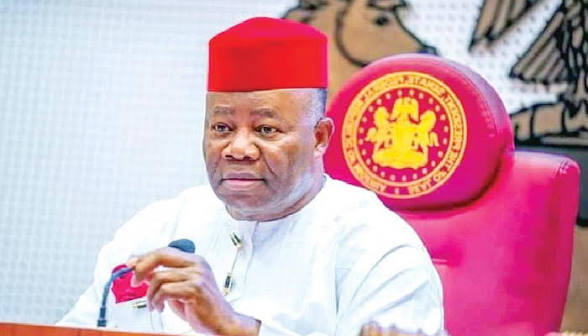
Senate President Godswill Akpabio says the All Progressives Congress (APC) will have enough achievements to present to Nigerians when it campaigns for President Bola Tinubu's re-election in 2027, placing the government's economic and social record at the centre of the coming political contest.
Akpabio made the statement in Uyo, Akwa Ibom State, while receiving members of the Senate Committee on Tertiary Institutions, TETFund and NELFUND, led by Senator Dandutse Mohammed. His comments were issued in a statement by his Special Assistant on Media, Jackson Udom, and independently reported by several Nigerian news organisations.
But the most consequential part of the statement is not simply that the Senate President believes APC has a strong campaign record. Akpabio also pointed to a specific measure of economic recovery, saying 27 states could not pay salaries and pensions when Tinubu assumed office. That figure is real as a description of a historical state-finance crisis, but available records show that the same 27-state figure was used years before Tinubu became president. That distinction matters when assessing what can reasonably be credited to the current administration.
Akpabio said the Tinubu administration inherited what he described as an economy “in shambles” and argued that conditions had improved through the government's reforms.
He said the administration would have substantial material to present to voters on the economy, agriculture, security, education and fiscal policy.
He also endorsed Tinubu for a second presidential term and said opposition politicians were aware of the administration's achievements but would not acknowledge them because of their political position.
The remarks came as the 2027 electoral process moves from preparation into open campaigning. Under INEC's revised timetable, presidential and National Assembly campaigns officially began on August 19, 2026, while governorship and state assembly campaigns are scheduled to begin on September 9. The presidential and National Assembly elections are scheduled for January 16, 2027, with governorship and state assembly elections following on February 6.
That timing gives Akpabio's comments a significance beyond an ordinary assessment of government performance: the APC is now operating within the formal campaign period for the presidential contest.
There are several areas where the administration has documented programmes and measurable outputs that can legitimately form part of its campaign record.
On education, the Federal Ministry of Information says NELFUND has benefited more than 1.5 million students across 301 institutions, with close to ₦300 billion disbursed in student loans and upkeep allowances.
The administration has also produced an official three-year scorecard listing achievements across areas including the economy, business support, skills, education and trade. The document says 1.5 million students benefited from NELFUND, while also reporting other government programmes and economic indicators.
Those figures establish that the programmes exist and that the government has reported substantial activity under them. They do not, by themselves, establish that Nigerians generally regard the administration's performance as successful.
That distinction is particularly important during an election campaign.
A government can demonstrate that a programme has reached a certain number of beneficiaries while voters may still judge the broader economy through inflation, purchasing power, employment, security, access to services and household income.
Akpabio said Tinubu inherited a situation in which 27 states could not pay salaries and pensions.
Advertisement
President Tinubu himself made a similar claim in August 2026 while defending the removal of petrol subsidy, saying 27 states had been unable to pay salaries and pensions before he assumed office.
The claim therefore cannot be dismissed as something Akpabio invented for this particular speech.
However, the historical record complicates the way the figure should be interpreted.
In 2015 and 2016, during the administration of President Muhammadu Buhari, Nigerian states were already facing a severe fiscal crisis. A contemporaneous report said Buhari stated that 27 states were struggling to pay workers' salaries.
A 2016 House of Representatives proceeding provides an even more specific public record. It said that falling oil prices and reduced Federation Account allocations had left more than two-thirds of Nigeria's states — precisely 27 — unable to meet financial obligations to workers. It recorded that the Federal Government approved ₦689.5 billion in bailout funds for 27 states.
A PwC report similarly records that the Federal Government provided a ₦338 billion bailout package to 27 states in 2015 to help meet salary obligations.
The figure was therefore associated with Nigeria's state-finance crisis long before Tinubu took office.
This does not prove that Tinubu inherited no fiscal problem. It shows instead that the “27 states” figure describes a recurring and longstanding weakness in state finances, rather than a condition that originated in May 2023.
The more relevant question for assessing Tinubu's claim is therefore not simply whether states were struggling before May 2023.
The question is whether the administration's reforms materially changed the ability of states to meet their obligations.
The government says they did.
In August 2026, Finance Minister and Coordinating Minister of the Economy Taiwo Oyedele said reforms had moved the number of states struggling to reliably pay salaries from 27 in May 2023 to zero. Reports of his presentation also linked the change to increased revenues following the removal of petrol subsidy.
The government has also argued that subsidy removal increased resources available to the three tiers of government. According to figures attributed to Oyedele, ₦15.8 trillion accrued to the Federation Account between June 2023 and December 2025 as a result of the removal of petrol subsidy, with ₦10.4 trillion shared to states and local governments.
These are significant figures, but they should not be confused with proof that every economic consequence of the reform has been positive.
The same government reporting acknowledges that the reforms came with costs, including higher prices and a sharp adjustment in the naira, with households and businesses experiencing the effects.
That creates a central tension in the government's emerging campaign argument: higher government revenue and improved state fiscal capacity do not necessarily mean improved household welfare for every Nigerian.
Akpabio's argument is ultimately political: APC believes the government's record will persuade voters to return Tinubu to office.
The evidence can establish individual achievements, spending figures, programme beneficiaries and changes in public finances. It cannot establish in advance how voters will evaluate those achievements.
For example, NELFUND's reported reach is measurable. Whether the programme has made education more affordable for Nigerian families is a broader question involving tuition, living costs, access, repayment arrangements and the number of eligible students who remain outside the programme.
Similarly, increased allocations to states can be measured. Whether those resources translate into better roads, hospitals, schools, wages and other public services requires examination at state and local levels.
This is why the government's campaign scorecard and the electorate's eventual assessment should not be treated as the same thing.
The APC's position is that Tinubu inherited a severe fiscal and economic crisis and that difficult reforms have improved the country's financial position.
Akpabio says the government has enough achievements to campaign on and specifically points to the economy, agriculture, security, education and fiscal policy.
The administration's official three-year scorecard similarly presents reforms and programme outputs as evidence of progress.
Opposition parties, however, have challenged important parts of the administration's economic approach, particularly the removal of petrol subsidy. Recent political arguments over whether subsidy should be restored demonstrate that the 2027 contest is likely to involve competing interpretations of the same economic changes.
The disagreement is therefore not principally about whether reforms occurred. It is about their cost, benefits, sustainability and who has benefited from them.
Akpabio's statement signals that the APC's 2027 campaign is likely to rely heavily on a record-of-government argument.
The party has tangible programmes and figures to present. NELFUND's reported expansion, changes in state revenues and the government's broader reform programme provide measurable material for that argument.
Advertisement
But the political test will be more demanding than producing a list of government programmes.
Nigeria's economic reforms have changed government finances while also producing substantial adjustment costs. The removal of petrol subsidy, currency reforms and other fiscal changes have affected prices and household purchasing power. The government itself acknowledges some of these costs.
The 2027 election will therefore give voters an opportunity to weigh two questions simultaneously: whether the government inherited a difficult situation, and whether the measures taken since 2023 have improved their own economic circumstances sufficiently to justify another term.
Several important questions cannot be answered by Akpabio's statement alone.
First, there is no single independent measure that establishes that the Tinubu administration has achieved an “unprecedented” record across the economy, agriculture, security, education and fiscal policy. Each claim requires separate evidence.
Second, the exact basis for saying that 27 states could not pay both salaries and pensions in May 2023 needs to be distinguished from the well-documented 27-state salary crisis that occurred during the Buhari administration. Historical records show that the number was already in widespread official use years earlier.
Third, the claim that zero states currently face salary-payment difficulties needs to be assessed against current state-level financial records rather than treated solely as a political statement.
Finally, programme-level achievements do not automatically answer the larger question of whether living standards have improved. That assessment requires broader economic and social data.
The APC's argument will now be tested during the formal 2027 campaign period.
INEC's revised timetable places the presidential and National Assembly election on January 16, 2027. Campaigning for those offices began on August 19, 2026, while governorship and state assembly campaigns are scheduled to begin on September 9.
The APC and opposition parties will therefore have increasing opportunities to present competing records of the Tinubu administration, while voters will ultimately judge the claims against their own experiences and the available evidence.
For Superior News, the key issue to watch is whether individual claims made during the campaign can be supported by independently verifiable data — particularly on state finances, inflation, purchasing power, employment, security, education and the effects of the government's fiscal reforms.
Akpabio is correct that the APC has a substantial list of policies and programmes it can campaign on. But the historical record shows that one of his most prominent examples — the 27-state salary crisis — did not begin with Tinubu's presidency.
The more important question for 2027 is therefore not simply whether the government can produce an achievements list. It is whether the evidence shows that the reforms since 2023 have produced sustainable improvements in public finances and, ultimately, meaningful improvements in the lives of Nigerians.
You must log in to comment or reply.
Comments