
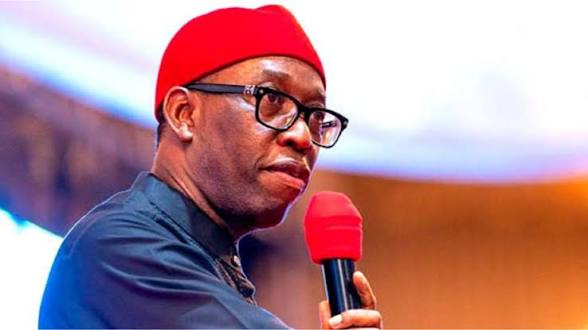
 Political tensions in Delta North are resurfacing around a familiar issue—state creation. But this time, the disagreement between Ifeanyi Okowa and Ned Nwoko signals more than policy differences; it reflects deeper strategic positioning ahead of 2027.
On April 21, 2026, former Delta State governor Ifeanyi Okowa publicly challenged Senator Ned Nwoko’s push for the creation of Anioma State. Speaking during a meeting with APC stakeholders in Oshimili South, Okowa accused Nwoko of misleading the people of Delta North.
Okowa stated:
“There’s been a lot of misconceptions… concerning Anioma State.”
He clarified his position, insisting that the proposed Anioma State should remain within the South-South geopolitical zone, with Asaba as its capital:
“The Anioma that we seek… is that they want the Anioma made up of the nine local governments… resident in the South South… with Asaba as headquarters.”
Advertisement
Taking a direct swipe at Nwoko, he added:
“Somebody who doesn’t even understand how it came suddenly wants to wish away that headquarters. It’s terrible. It’s unwise.”
However, a closer look shows that this is not just about geography—it is about control, identity, and political leverage.
The debate over whether Anioma should align with the South-South or South-East carries implications beyond administrative boundaries. It touches on representation, resource allocation, and cultural affiliation.
What makes this more complex is timing. Okowa’s remarks come amid consultations linked to his potential return to the Senate in 2027, positioning him directly against Nwoko.
By accusing Nwoko of pursuing the agenda as a “one-man show,” Okowa is not only challenging the proposal but also framing himself as a more consultative leader:
“When you believe you know it all, you go the wrong path.”
For residents of Asaba and surrounding areas, the issue is practical as well. The status of the city as a capital carries economic implications—affecting infrastructure, investment, and regional development.
Calls for the creation of Anioma State have persisted for decades, reflecting long-standing demands for administrative autonomy within Delta North.
Nigeria currently operates with 36 states, but agitation for additional states remains common, often tied to ethnic identity and perceived marginalization.
Advertisement
Historically, state creation debates intensify during election cycles, as political actors align themselves with popular regional demands to strengthen support bases.
In this case, the Anioma question intersects with broader geopolitical sensitivities between Nigeria’s South-South and South-East zones.
The real concern now is whether the Anioma debate will remain a policy discussion or evolve into a defining political battleground ahead of 2027.
For Delta North, the stakes go beyond rhetoric. What leaders agree on—or fail to agree on—will shape not just electoral outcomes, but the region’s long-term political identity and development path.
You must log in to comment or reply.
Comments