
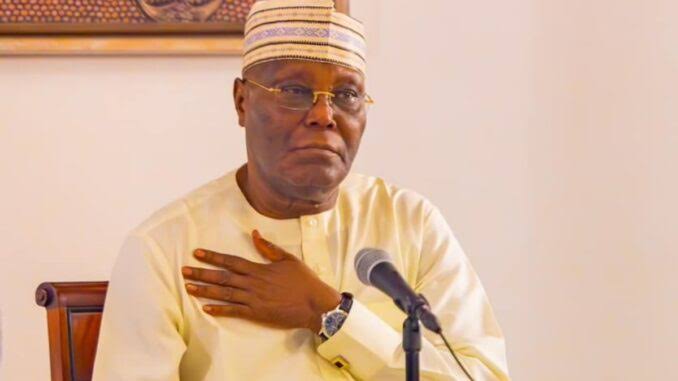
Nigeria's political tensions have intensified after former Vice President Atiku Abubakar called on President Bola Tinubu to apologise to Nigerians and resign over the growing controversy surrounding the Presidential Foreign Investment Promotion Council (PFIPC). The demand comes as conflicting accounts from two key federal institutions continue to fuel questions about transparency, accountability and oversight in government financial processes.
Former Vice President and African Democratic Congress (ADC) presidential candidate Atiku Abubakar on Wednesday urged President Bola Tinubu to either order an independent investigation into the PFIPC controversy or accept political responsibility by stepping down.
In a statement issued by his Special Assistant on Public Communication, Phrank Shaibu, Atiku argued that contradictory positions taken by the Office of the Accountant-General of the Federation (OAGF) and the Central Bank of Nigeria (CBN) have created a serious credibility challenge for the administration.
According to Atiku, the OAGF had denied authorising the opening of PFIPC-related accounts and alleged forgery, while the CBN told the House of Representatives that the accounts were opened following directives from the Accountant-General and that due process was followed. He questioned how both positions could be true simultaneously.
The former vice president challenged President Tinubu to publicly clarify which version of events his administration accepts and criticised what he described as the silence of the Attorney-General of the Federation. He also urged the National Assembly to invite both the Accountant-General and the CBN Governor to testify jointly before its investigative committee.
Atiku further argued that if the government cannot restore public confidence through a credible independent investigation and hold those responsible accountable, the President should apologise to Nigerians and resign.
Advertisement
These remarks represent the opposition leader's political position and should not be interpreted as established findings of wrongdoing.
Punch focused on Atiku's call for President Tinubu's resignation and his criticism of conflicting statements from the OAGF and the CBN.
Channels Television placed greater emphasis on the House of Representatives' investigation, highlighting testimony from a CBN director who said two PFIPC accounts were opened on instructions from the Accountant-General's office but never received any deposits or remittances.
The Presidency has also responded separately to the wider controversy. Earlier this month, President Tinubu directed the Independent Corrupt Practices and Other Related Offences Commission (ICPC) to investigate the activities of the controversial PFIPC, describing it as a fictitious entity with no legal basis and ordering a report within 30 days.
Several Nigerian media organisations, including The Guardian, Vanguard and Legit.ng, similarly reported Atiku's demands but noted that the House of Representatives' investigation into the matter remains ongoing.
The PFIPC controversy has evolved beyond questions about a disputed government entity into a broader debate about institutional accountability and coordination within Nigeria's public financial system.
The key issue is no longer only whether the council was legitimately established but whether federal institutions maintained consistent documentation, oversight and communication when handling official requests.
Conflicting testimony between the country's central bank and the Office of the Accountant-General has also intensified political criticism at a time when public confidence in governance and fiscal transparency remains under close scrutiny.
For the opposition, the controversy has become a platform to question the administration's credibility. For the government, the outcome of ongoing investigations could determine whether the matter is viewed as an isolated case of alleged fraud or evidence of wider institutional weaknesses.
The PFIPC controversy emerged after allegations that a body presented as the Presidential Foreign Investment Promotion Council—or, in earlier official statements, the Presidential Foreign Intervention Promotion Council—was operating despite lacking legal establishment. The Presidency subsequently announced an ICPC investigation into alleged forged appointment letters, fraudulent use of government documents and the opening of bank accounts linked to the entity.
Advertisement
The House of Representatives has launched its own inquiry, while testimony from the CBN indicated that the disputed accounts remained dormant and recorded no inflows or transactions.
Political analysts note that investigations involving financial oversight institutions often become significant tests of public confidence because they involve agencies responsible for safeguarding government funds and maintaining the integrity of public financial administration.
The immediate focus now shifts to the House of Representatives' investigation and the ICPC probe ordered by President Tinubu.
Whether those inquiries reconcile the conflicting accounts presented by the OAGF and the CBN may determine how the controversy affects public trust in government institutions. As political reactions continue to intensify, the findings of investigators—not political statements—are likely to shape the next phase of the debate.
You must log in to comment or reply.
Comments