
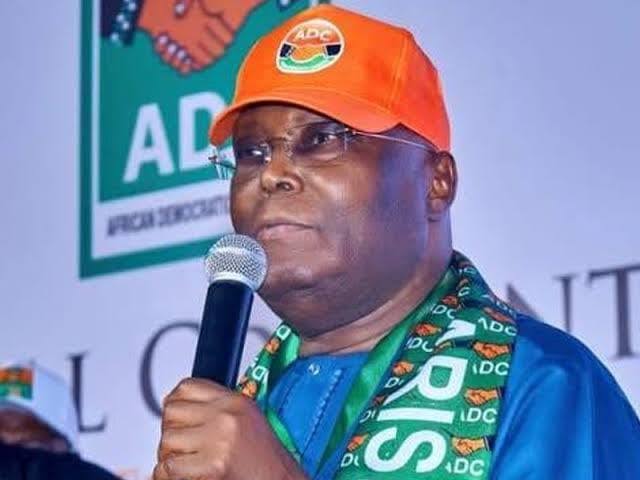
Former Vice President Atiku Abubakar has promised to reopen Nigeria’s land borders and expand the capacity of southern ports if elected president in 2027, arguing that restrictions on cross-border commerce and weaknesses in the country’s transport network have hurt businesses and employment.
The African Democratic Congress presidential candidate made the comments while addressing supporters in a video circulated online and shared by ADC chieftain Dele Momodu. Atiku linked the border policy to the economic difficulties faced by traders in northern states that depend on commerce with neighbouring countries.
He also proposed greater use of ports in the South, including facilities around Calabar, Uyo and Port Harcourt, as part of a broader strategy to reduce the cost and time involved in moving imported goods toward northern Nigeria.
The proposal raises an important policy question: should Nigeria respond to smuggling and security problems primarily through tighter border controls, or can more open, regulated trade produce better economic results while still protecting national security?
Atiku said Nigeria's land borders with neighbouring countries had disrupted legitimate transborder businesses and contributed to unemployment among young people.
He specifically referred to traders in northern states bordering Cameroon, Chad, Niger and Benin Republic. According to him, some young entrepreneurs who previously operated businesses with millions of naira in capital lost their businesses after border restrictions were introduced.
His position is therefore not simply about removing border controls. It is an argument that Nigeria should allow legitimate commercial activity to operate more freely while addressing illegal trade through enforcement.
Atiku also connected border policy with Nigeria's port infrastructure.
He said he had previously engaged European shipping and port-development companies about developing ports in southern Nigeria. His argument is that a more geographically balanced port system could make it easier to move goods toward the North-East instead of concentrating much of the country's maritime cargo activity around Lagos.
He gave Yola in Adamawa State as an example, saying goods discharged at Calabar, Uyo or Port Harcourt could potentially reach the North-East much faster if the necessary transport infrastructure existed.
That particular estimate remains Atiku's claim. The available evidence does not independently establish that a container currently takes exactly two months to travel from Lagos to Yola or that a southern-port route would consistently reduce the journey to 24 hours.
The history of Nigeria's border policy shows why the proposal is more complicated than simply opening gates.
The Buhari administration introduced a major restriction on land-border trade in 2019 amid concerns over smuggling and the effect of imported goods on domestic production.
The security argument was also broader than food imports.
In January 2020, the Presidency said the government was concerned about weapons, ammunition and hard drugs being moved through the country's borders alongside food products. Buhari argued at the time that Nigeria could not ignore the security consequences of uncontrolled movement across its borders.
Nigeria Customs has continued to report seizures involving prohibited or restricted goods. In its 2024 briefing, the service reported interceptions including arms and ammunition, narcotics, foreign rice and petroleum products, illustrating that the enforcement problem did not disappear with changes to individual border policies.
That creates the central policy challenge for any future government: how to increase legitimate trade without creating new opportunities for smuggling, weapons trafficking or other illegal activity.
Advertisement
Nigeria has already moved toward selective reopening
One important part of the current debate is that Nigeria's borders are not simply in a permanent state of closure.
In February 2026, the Federal Government reopened the Kamba and Tsamiya corridors in Kebbi State.
The Nigeria Customs Service said the Tsamiya–Segbana corridor was reopened for transit operations and that officials would enforce procedures governing legitimate goods moving between Nigeria, Benin and Niger. Customs specifically warned against diverting transit cargo into Nigeria's domestic market.
The reopening had immediate commercial consequences. Reports at the time said thousands of trucks that had been stranded around the affected border routes began moving again.
The Presidency subsequently described the reopening as an effort to restore cross-border trade while strengthening regional cooperation.
Nigeria also formally lifted its broader land-border and other sanctions against Niger in March 2024 following an ECOWAS decision to remove sanctions imposed after the military takeover in Niger.
These developments are significant because they show that the current policy debate is not simply about closed borders versus open borders.
In practice, Nigeria has been moving toward a model in which particular corridors can operate under customs, security and transit controls.
The second part of Atiku's proposal concerns a different weakness in Nigeria's trade system: the connection between seaports and the country's interior.
Nigeria's economic geography means that imported goods entering through southern ports must travel long distances to reach landlocked commercial centres in the North.
Atiku argues that developing additional southern maritime gateways could create alternative routes and reduce pressure on the existing logistics network.
His example of Calabar, Uyo and Port Harcourt reflects an attempt to connect maritime infrastructure with inland distribution.
But ports alone cannot solve the problem.
A container arriving at a southern port still requires an efficient road or rail network to reach the North. Poor roads, congestion, customs procedures, security problems and delays along the corridor can erase some of the potential advantage of a shorter maritime route.
This means that the port proposal is ultimately also a transport infrastructure proposal.
The government's position presents a different concern
The historical government argument for restrictions has centred on national security, protection of domestic production and prevention of illegal imports.
The State House said in 2020 that the border restrictions were partly intended to protect Nigerian farmers and domestic production while addressing the movement of weapons and drugs.
Customs enforcement records show that smuggling remains an active problem.
In March 2026, for example, Customs reported seizures involving foreign rice, petroleum products, used vehicles and other restricted goods, while reiterating that enforcement was intended to protect legitimate trade, government revenue and domestic producers.
That evidence does not prove that reopening borders would necessarily increase insecurity or smuggling. But it does demonstrate why any policy of wider reopening would require an enforcement mechanism rather than simply eliminating restrictions.
What could change if Atiku's proposal were implemented?
The potential economic benefits would depend heavily on implementation.
For border communities and traders, easier movement could reduce the cost and uncertainty associated with legitimate cross-border commerce.
For northern consumers and businesses, improved trade corridors could potentially increase the availability of goods and reduce some transportation bottlenecks.
For southern ports, increased cargo activity could create opportunities for logistics companies, transport operators and port-related businesses.
There could also be regional benefits because Nigeria sits at the centre of several important West African trade routes.
But there are competing risks.
If border controls were relaxed without effective customs monitoring, prohibited goods could become easier to move into Nigeria. Domestic manufacturers and farmers could also face stronger competition from imported products.
The experience of the 2026 Tsamiya–Kamba reopening demonstrates the approach Nigeria's current authorities have taken: facilitate legitimate transit while maintaining controls against diversion and smuggling.
Atiku's proposal would therefore need to answer a practical question: what would replace the existing restrictions, and how would the new system prevent the problems that originally prompted tighter controls?
Several important details of Atiku's proposal have not yet been publicly established in the material reviewed for this report.
Advertisement
It is not yet clear:
- Which specific land borders would be reopened first if he became president.
- Whether the proposal would mean unrestricted movement or a regulated customs system.
- What new security measures would accompany the reopening.
- How Nigeria would prevent smuggling while increasing legitimate trade.
- Which southern ports would receive priority investment.
- How much the proposed port development would cost.
- Which shipping or port-development companies would participate.
- What road or rail projects would connect the ports to the North-East.
- Whether the claimed reduction in cargo-delivery time could be achieved in practice.
These questions are important because the success of the policy would depend less on the announcement itself than on the system created to implement it.
Atiku's comments form part of the political debate ahead of Nigeria's 2027 presidential election. The proposal will therefore need to be developed into a clearer policy programme if the ADC campaign intends to make border and port reform a major economic plank.
Meanwhile, the Federal Government's existing approach provides a real-world test of regulated border reopening.
The February 2026 reopening of the Tsamiya–Kamba corridor is already being operated with customs oversight and restrictions designed to prevent legitimate transit cargo from being diverted into Nigeria's domestic market.
That experience could become relevant to the wider political argument over whether Nigeria should expand regulated cross-border trade.
For now, Atiku has established the direction of his proposal, but the most consequential details — which borders, what controls, which ports, what investment and how security would be maintained — remain to be defined.
You must log in to comment or reply.
Comments