
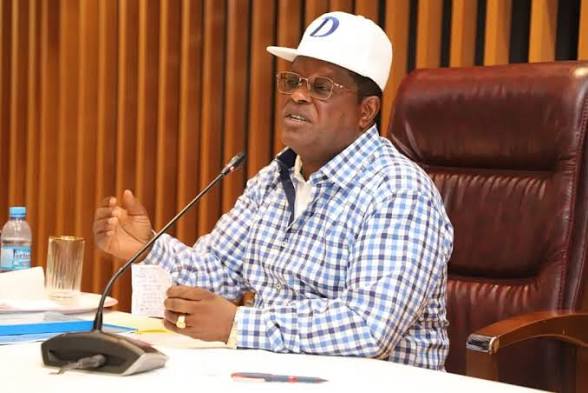
The future of one of Nigeria’s most strategic coastal road projects is increasingly being tied to political continuity ahead of the 2027 elections. As the Bodo–Bonny Road begins to transform access to Bonny Island in Rivers State, the Minister of Works, David Umahi, is urging communities along the corridor to back President Bola Ahmed Tinubu for another term to ensure the next phase of the project is completed.
On Friday, the federal government’s infrastructure push in the Niger Delta took on a political undertone when the Minister of Works called on stakeholders along the Bodo–Bonny corridor to support the re-election of President Tinubu. Umahi made the appeal during a Medallion Award Ceremony organised by the Bodo-Bonny Road and Bridges Peace Committee in Abuja, where he was represented by the Minister of State for Works, Bello Goronyo.
The event celebrated progress on the long-awaited road linking Bonny Island to mainland Rivers State. For decades, the oil-rich island—home to critical energy infrastructure—remained accessible primarily by water transport despite hosting major industrial facilities. According to officials, the completion of the first phase has begun changing that dynamic, opening up new possibilities for trade, logistics and local mobility across the Niger Delta.
Advertisement
However, a closer look shows the government’s messaging increasingly connects the project’s future to electoral politics. Umahi said Phase II of the road project has already received presidential approval and that preparations to commence work are underway. Yet he urged host communities to rally behind Tinubu to guarantee the continuation of the initiative beyond the current administration.
Beyond the official statement, the remark reflects a broader strategy common in Nigeria’s infrastructure politics—linking large-scale development projects to political stability and continuity. With construction projects often spanning multiple administrations, ministers frequently argue that a change in leadership can slow implementation or shift priorities. In this case, the message is directed at communities that stand to benefit directly from the road’s expansion.
What makes this more complex is the economic significance of the Bodo–Bonny corridor. Bonny Island hosts major oil and gas installations that play a critical role in Nigeria’s energy exports. Improved road connectivity could significantly reduce logistics costs, enhance security, and integrate coastal communities more closely with regional markets.
While Punch Newspapers highlighted Umahi’s call for political support as the main headline, other reports placed greater emphasis on the project’s infrastructure impact and the years of delays that slowed progress. Stakeholders involved in the ceremony described the road’s completion as the end of decades of agitation by residents and industry players who had long argued that the region’s economic importance was not matched by infrastructure investment.
That framing leaves out another key context: the project’s revival was largely enabled by funding reforms introduced under former Works Minister Babatunde Fashola. Through an infrastructure tax credit scheme linked to federal policy reforms, private sector funding—particularly from energy companies operating in the region—helped unlock stalled construction.
Advertisement
Historically, major federal road projects in Nigeria have faced persistent obstacles, including funding shortages, contractor disputes and community tensions. The Bodo–Bonny project itself experienced years of setbacks before gaining renewed momentum in recent administrations. Its progress is therefore being closely watched as a test case for alternative infrastructure financing models.
For residents of coastal communities in Rivers State, the stakes are tangible. Improved road access could reduce travel times, increase commercial activity and improve security in an area historically affected by isolation and maritime transport risks. Yet the deeper issue is whether long-term infrastructure planning in Nigeria can remain insulated from electoral cycles.
You must log in to comment or reply.
Comments