
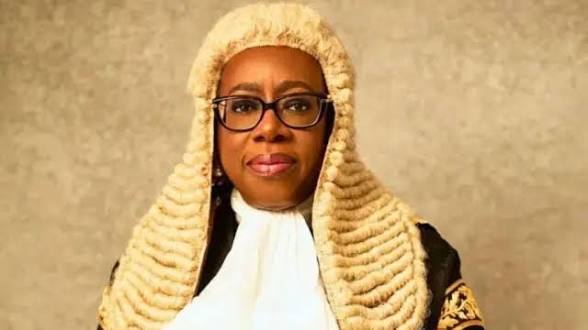
A new directive from Nigeria's highest court is drawing attention to a long-standing practice within the legal profession. By ordering lawyers and court officials to stop using the title "Barrister" as a prefix to their names in official Supreme Court engagements, the judiciary is signalling that professional identity should be guided by established legal standards rather than custom.
Although the change may appear administrative, it reflects a broader effort to reinforce discipline, uniformity and professionalism across Nigeria's judicial system at a time when confidence in public institutions remains under close scrutiny.
Chief Justice of Nigeria (CJN), Justice Kudirat Kekere-Ekun, has directed legal practitioners, court registrars, litigation staff and other officials engaging with the Supreme Court to discontinue the use of the title "Barrister" before their names in all official communications.
The directive was conveyed through a memorandum dated July 13, 2026, signed by the Chief Registrar of the Supreme Court, Kabir Akanbi, with immediate effect.
According to the circular, the use of "Barrister" as a name prefix is considered inappropriate and inconsistent with the professional standards expected within Nigeria's apex court.
The directive applies to official correspondence, court records, documents, identity materials and every formal engagement involving the Supreme Court.
Heads of departments and unit supervisors have also been instructed to ensure full compliance among officers under their supervision.
Advertisement
Importantly, the order does not remove the legal qualification of lawyers as Barristers and Solicitors of the Supreme Court of Nigeria. Instead, it restricts the use of "Barrister" as a courtesy title before names in official Supreme Court business.
Punch focused primarily on the contents of the Chief Registrar's memorandum and the immediate implementation of the directive within the Supreme Court.
Premium Times and reports surrounding the 2026 Call to the Nigerian Bar placed the development within a wider conversation about professional ethics. They highlighted earlier warnings by the Council of Legal Education and the Body of Benchers, both of which cautioned against the improper use of legal titles and legal regalia before formal qualification.
Channels Television, meanwhile, has recently reported on broader judicial reforms introduced under Justice Kekere-Ekun, presenting the directive as part of a wider institutional effort to improve efficiency, professionalism and public confidence in Nigeria's judiciary.
Taken together, these reports suggest the memorandum is not an isolated decision but part of a continuing reform agenda within the legal profession.
The debate extends beyond whether lawyers should introduce themselves as "Barrister."
Nigeria's legal profession has historically placed significant symbolic value on titles, robes and courtroom traditions. However, judicial regulators have increasingly argued that professionalism should be demonstrated through competence, ethics and adherence to established rules rather than honorary prefixes.
The Supreme Court's decision also reinforces the distinction between professional qualification and professional title. Every lawyer called to the Nigerian Bar remains legally recognised as a Barrister and Solicitor, but that qualification does not necessarily require "Barrister" to appear before a person's name in official judicial communications.
For younger lawyers entering practice, particularly in Lagos, Abuja and other major legal centres, the directive may encourage greater consistency in legal documentation and reduce confusion surrounding professional designations.
The change also aligns with global legal practice, where lawyers in many common-law jurisdictions rarely use "Barrister" as a routine courtesy title in official correspondence.
The directive follows several recent initiatives aimed at strengthening standards within Nigeria's legal profession.
Earlier in July 2026, the Council of Legal Education warned prospective lawyers against wearing wigs and gowns or presenting themselves as qualified practitioners before being formally called to the Bar, describing such conduct as inconsistent with professional ethics.
Advertisement
Similarly, the Body of Benchers emphasised during the 2026 Call to the Bar ceremonies that "Barrister" should not be treated as a personal title preceding names.
These developments form part of broader judicial reforms under Chief Justice Kekere-Ekun, whose administration has introduced measures intended to improve court administration, case management and institutional credibility.
While the practical impact of removing a title may appear limited, legal experts often note that institutional reforms frequently begin with procedural consistency before extending to wider administrative changes.
The immediate effect of the directive is limited to official engagements involving the Supreme Court, but its influence could spread across other courts, law firms and legal institutions if widely adopted.
Whether similar guidance emerges from lower courts or professional associations remains to be seen. What is already clear is that Nigeria's judiciary is placing renewed emphasis on professional identity, institutional discipline and the standards expected within the country's highest court.
You must log in to comment or reply.
Comments