
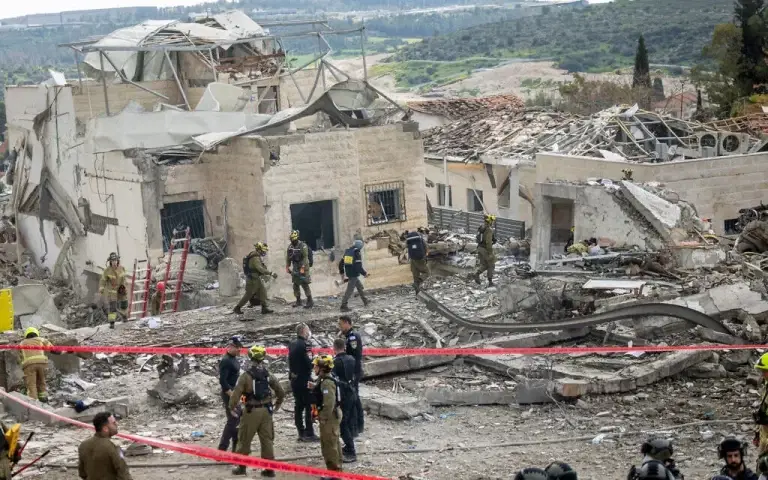
Missiles over the Gulf, drones over luxury skylines, sirens in Jerusalem — the confrontation between Israel and Iran has moved beyond a bilateral clash. What began as Israeli “preventive strikes” on Tehran has rapidly evolved into a multi-country security crisis now engulfing key Gulf states.
The immediate question was whether Iran’s sweeping missile and drone campaign constituted retaliation. Regional reporting patterns, official statements, and strike sequencing leave little ambiguity: this was a direct response — but one designed to reshape the battlefield
On February 28, Israel announced it had launched preemptive airstrikes against Iranian targets, citing intelligence on ballistic missile threats and Iran’s support for armed regional proxies. Explosions were reported in Tehran, while emergency sirens sounded across Jerusalem.
Israeli officials framed the action as defensive and necessary. Iranian state media confirmed impacts and signaled retaliation would follow.
What many early reports emphasized was the legality and immediacy of Israel’s action. Less examined was how Tehran would choose to respond — and whether it would limit its retaliation to Israeli territory.
Within hours, Iran launched ballistic missiles, cruise missiles and more than 500 drones, according to Gulf authorities. The hardest hit included:
• United Arab Emirates
• Bahrain
• Qatar
• Kuwait
Advertisement
• Oman
UAE officials confirmed fatalities and dozens injured. Airports, residential towers, energy-linked facilities and hotels were struck or damaged by falling debris from intercepted drones.
International wires focused heavily on interception numbers and casualty figures. Yet the broader implication is strategic: Iran did not confine its retaliation to Israel. It widened the theatre.
That shift transforms the crisis from a bilateral confrontation into a regional security event with economic consequences.
Iran’s targeting pattern appears calculated rather than indiscriminate.
Most Gulf monarchies host US military installations. Bahrain is home to the US Navy’s Fifth Fleet. Qatar hosts the region’s largest American air base. The UAE maintains deep defense ties with Washington.
By striking across the Gulf, Tehran may be pursuing multiple objectives simultaneously:
• Raising the cost for states aligned with Washington
• Signaling that any strike on Iranian territory carries regional consequences
• Pressuring energy markets and global supply chains
• Complicating direct Israeli counter-retaliation
There is no confirmed evidence that Washington initiated Israel’s strike. However, the United States has significantly expanded its military presence in the region in recent months.
American facilities were reportedly targeted during the Iranian barrage, and US embassies issued security advisories urging caution.
That leaves a delicate balancing act. If the US responds militarily, the conflict risks expanding. If it refrains, deterrence calculations across the region may shift.
The crisis now carries the potential trajectory:
Iran vs Israel → Iran vs Gulf states → Iran vs a broader US-backed coalition.
Previous exchanges between Israel and Iran have typically been limited, deniable, or geographically contained. This round differs in several ways:
• Civilian airports were struck.
• Hotels and high-rise residential buildings were impacted.
Advertisement
• Multiple sovereign Gulf states were involved simultaneously.
• Energy infrastructure was placed at risk.
That combination introduces reputational, economic, and diplomatic costs beyond immediate military damage.
More importantly, it places Gulf governments — long positioned as mediators or stabilizers — directly in the conflict’s line of fire.
Security analysts now point to three plausible near-term scenarios:
• Diplomatic de-escalation led by Gulf Cooperation Council states and Western intermediaries
• Limited counter-strikes targeting Iranian military infrastructure
• Escalation via proxy groups in Lebanon, Yemen, Iraq, or Syria
Oil markets and maritime insurance rates are likely to be the first measurable indicators of where this crisis heads.
You must log in to comment or reply.
Comments