
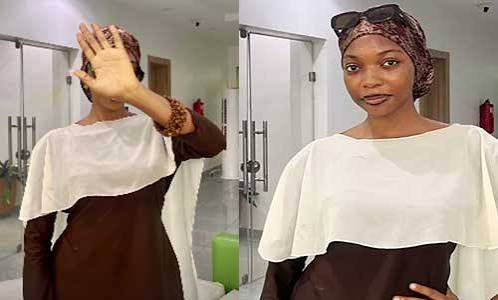
 For most Nigerians, placing a finger on a biometric scanner is a routine part of registering for an examination, completing identification procedures or accessing certain services. For people born without usable fingerprint patterns, however, that simple process can become a significant barrier.
A Nigerian woman known online as J for Jidds has shared how living with adermatoglyphia, a rare condition involving absent or greatly reduced fingerprint ridges, has affected her interactions with biometric systems, including those used for JAMB, NYSC and banking.
Her account also highlights a wider issue: identification systems built around fingerprints can be difficult to navigate for people whose fingerprints cannot be captured or recognised.
Jidds said she discovered the problem in 2017 while registering for her first Joint Admissions and Matriculation Board examination.
According to her account, officials initially struggled to capture her fingerprints. She said she spent the day at the registration centre with her father while other candidates completed their registration.
She recalled that several methods were attempted to make her fingerprints readable, including sand, spirit, methylated spirit, chalk and watermelon. At one point, she said she scrubbed her hand against a stone before she was eventually able to complete the registration.
The problem also affected her examination experience.
“Sometimes I would be able to thumbprint in and I will not be able to thumbprint out.”
She later encountered similar difficulties during the National Youth Service Corps programme and banking transactions, according to her account.
Advertisement
Jidds said that during NYSC, she resorted to using her foot for biometric verification because the ridges on her toes were also too faint.
Jidds described the repeated encounters with fingerprint systems as stressful.
“Living in Nigeria without fingerprints has been—has been terrible, honestly.”
She said the difficulty extends beyond one institution because biometric identification is used in several areas of Nigerian public and commercial life.
Her experience is presented here as her personal account. The specific methods she says were attempted during registration have not been independently verified.
Adermatoglyphia is a medically recognised rare condition in which the normal ridge patterns that produce fingerprints are absent or significantly reduced.
The broader problem described by Jidds, however, is supported by medical evidence from Nigeria.
Research involving dermatologists at the University of Port Harcourt Teaching Hospital documented Nigerian cases of adermatoglyphia. One reported patient, a 21-year-old female undergraduate, experienced difficulty having fingerprints captured for JAMB, BVN and national identity-card procedures.
The researchers also examined alternative identification possibilities, including toe and lip prints.
This means that difficulties with fingerprint-based identification are not unique to Jidds' experience.
Fingerprint identification is designed to make verification easier and more secure, but systems based on a single biometric characteristic can create problems for people who cannot provide that characteristic.
For affected students, this can become relevant during examination registration or authentication. For people entering employment or participating in government programmes, biometric requirements can create additional hurdles.
Banking and identity systems can present another challenge because customers may be required to authenticate their identity using biometric information.
The issue is therefore not whether fingerprint technology works for most people. It is whether there are reliable alternatives when it does not work for a particular individual.
Jidds said she initially believed she was the only person in Nigeria experiencing the condition.
She later made a light-hearted post about being born without fingerprints and said that almost 100 people contacted her claiming to have experienced the same issue.
Advertisement
That figure is her account of responses to her social-media post, not an official estimate of the number of Nigerians living with adermatoglyphia.
Medical literature confirms that the condition is rare, while Nigerian medical researchers have previously documented cases involving difficulties with biometric identification.
There is no indication in the available material that Nigeria is introducing a specific nationwide biometric policy in response to Jidds' story.
The practical issue remains how individuals who cannot provide usable fingerprints can obtain reliable alternatives when fingerprint verification is required.
Medical literature has documented alternative biometric possibilities, but the availability and acceptance of those alternatives may depend on the institution involved.
Jidds' experience illustrates a practical limitation of systems that assume everyone can provide a readable fingerprint.
For most people, biometric verification may take seconds. For someone with adermatoglyphia, it can become a recurring obstacle across education, government programmes and financial services.
The wider question is whether biometric systems can provide clear, accessible alternatives for people whose fingerprints cannot be captured in the first place.
You must log in to comment or reply.
Comments