
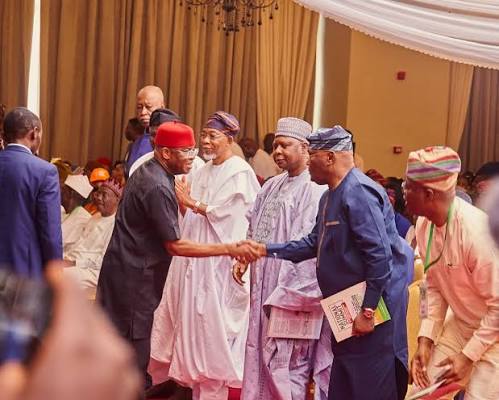
A high-profile opposition gathering in Ibadan meant to signal unity ahead of Nigeria’s 2027 elections is instead exposing widening fractures across major political parties. What emerged from the meeting is not a consolidated front, but a contested narrative of legitimacy, leadership, and strategy.
On April 25, 2026, prominent opposition figures — including Atiku Abubakar, Peter Obi, Rabiu Kwankwaso, and Seyi Makinde — convened in Ibadan, Ibadan, for an opposition summit aimed at forming a coalition to challenge President Bola Tinubu in 2027.
A communiqué issued after the meeting proposed a single opposition presidential candidate, warning against what participants described as a drift toward a one-party state under the ruling All Progressives Congress.
However, within 24 hours, multiple political parties — including factions of the Peoples Democratic Party, African Democratic Congress, Labour Party, and Accord Party — publicly disowned the summit, rejecting both its legitimacy and its resolutions.
Advertisement
The immediate controversy centers on legitimacy. The Wike-aligned faction of the PDP insists those present in Ibadan were not authorized representatives, describing them as “impostors” acting outside party structures. Similarly, rival factions within the ADC rejected the summit outright, while the Labour Party distanced itself, prioritizing internal leadership restructuring over coalition talks.
Yet the deeper issue is structural: Nigeria’s opposition remains fragmented along lines of leadership, ideology, and control of party machinery.
What makes this more complex is that many of the figures pushing for unity — including Atiku, Obi, and Kwankwaso — have overlapping political histories and competing presidential ambitions. Without a clear mechanism for candidate selection, the idea of a single ticket risks becoming more symbolic than actionable.
The Accord Party’s threat of legal action over the alleged unauthorized use of its identity adds another layer — suggesting that even the appearance of unity may have been constructed without full consent.
Nigeria’s opposition has faced similar coordination challenges before. Ahead of the 2015 elections, a coalition of parties successfully merged to form the APC, ultimately defeating the incumbent government. However, that success was built on formal party mergers and negotiated power-sharing agreements, not informal summits.
By contrast, the current effort appears less institutionalized. Data from recent electoral cycles shows increasing party fragmentation, with smaller parties gaining visibility but lacking the structure to sustain national coalitions.
Meanwhile, references to “Operation Wetie” — a violent political crisis in Western Nigeria in 1965 — introduced historical tension into the discourse. Critics, including the APC, interpreted Governor Makinde’s remarks as inflammatory, while his defenders argue it was a cautionary reference to the dangers of political exclusion.
What emerges from Ibadan is not a unified opposition strategy, but a contested political space where multiple actors claim authority without consensus.
Advertisement
The real test now is whether opposition leaders can move beyond symbolic gatherings and build a coherent, legally recognized coalition framework. Without that, the risk is clear: fragmentation could once again hand strategic advantage to the ruling party.
At the same time, the APC’s swift dismissal of the summit as unserious reflects confidence — but also signals that the ruling party is closely watching any attempt at opposition consolidation.
What authorities and party leaders do next will determine whether Ibadan becomes a turning point for opposition unity — or further proof of its limits.
You must log in to comment or reply.
Comments