
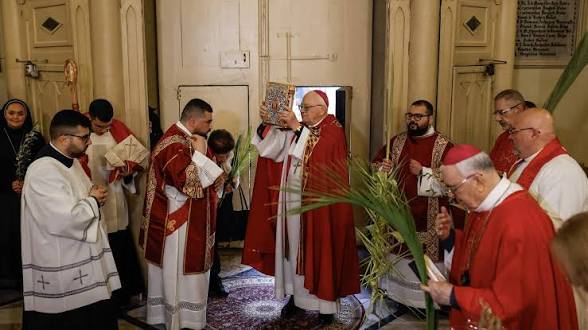
The disruption of Palm Sunday observances in Jerusalem has triggered a diplomatic backlash in Europe, raising urgent questions about how far wartime security measures can extend into religious life. What unfolded at one of Christianity’s holiest sites is now reverberating beyond the Middle East, drawing in global political actors and deepening tensions around religious freedom.
On March 29, 2026, Israeli police prevented Pierbattista Pizzaballa from entering the Church of the Holy Sepulchre to celebrate Palm Sunday mass, according to multiple international reports. The restriction came amid heightened security measures tied to the ongoing regional conflict involving Israel and Iran, which has led authorities to limit large public gatherings across religious sites.
Italy reacted swiftly. Prime Minister Giorgia Meloni described the move as an “offence to the faithful,” while Foreign Minister Antonio Tajani summoned Israel’s ambassador in protest. Similar criticism emerged from France, signaling a broader European concern over the incident.
Advertisement
However, a closer look at international coverage reveals subtle differences in framing. While Reuters emphasized the unprecedented nature of blocking a senior Catholic figure during a major religious event, other outlets focused more heavily on Israel’s security justification tied to ongoing hostilities. That framing leaves out a deeper tension: the collision between national security policies and long-standing religious traditions in one of the world’s most contested cities.
Beyond the official statements, the incident underscores how conflict is now reshaping civilian and spiritual life across the region. Palm Sunday traditionally draws thousands of pilgrims to Jerusalem, marking the beginning of Holy Week. This year, not only was access restricted, but the customary procession from the Mount of Olives was also cancelled—an extraordinary break from centuries-old practice.
What makes this more complex is the broader regional context. The escalation involving Israel and Iran has already disrupted Muslim, Jewish, and Christian observances simultaneously, placing governments in the difficult position of balancing security with fundamental freedoms. Yet the optics of preventing a high-ranking cleric from entering Christianity’s holiest site risk amplifying perceptions of religious suppression, regardless of intent.
For Nigerian readers, where religious coexistence remains a sensitive national issue, the development highlights how quickly security narratives can intersect with faith. Similar tensions have historically triggered unrest in multi-religious societies, making the management of such incidents critical not just locally, but globally.
Advertisement
Historically, access to the Church of the Holy Sepulchre has been fiercely protected even during periods of conflict. Restrictions of this scale are rare, and their re-emergence signals a shift in how modern conflicts are being managed—where even symbolic spaces are no longer insulated.
What authorities do next will determine whether this remains a security incident or escalates into a broader diplomatic and religious dispute. The balance between safety and freedom, already under strain, is now being tested in one of the most visible ways possible.
You must log in to comment or reply.
Comments