
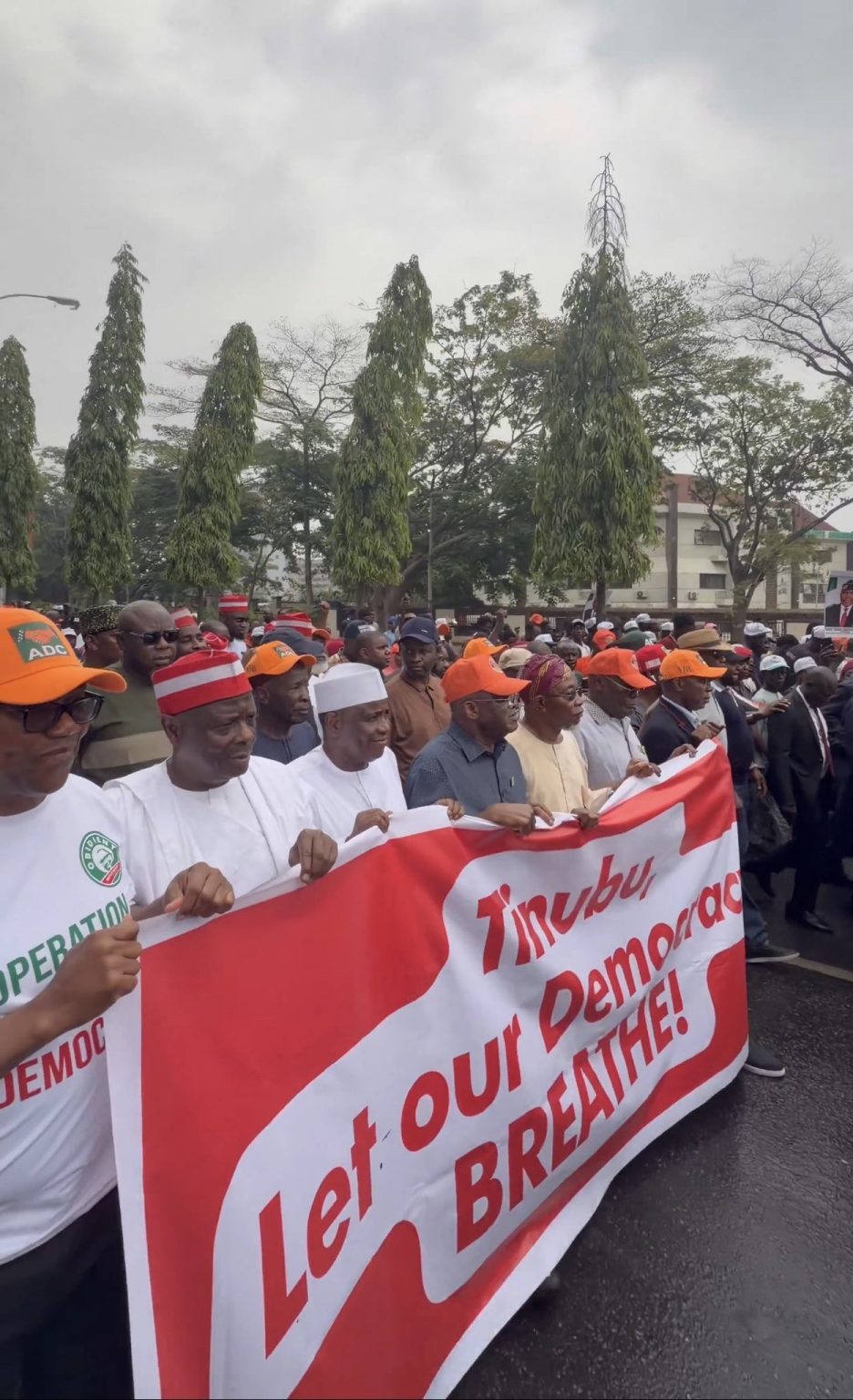
Abuja, Nigeria — April 8, 2026: What began as a protest over party leadership recognition has, within hours, revealed an unexpected strategic realignment in Nigeria’s opposition politics — a development with implications far beyond Thursday’s rain‑soaked march to the Independent National Electoral Commission (INEC) headquarters.
Prominent political figures from across ideological lines — Atiku Abubakar, Peter Obi, Rabiu Kwankwaso, Rotimi Amaechi, Rauf Aregbesola, Aminu Tambuwal, David Mark, and others — stood shoulder to shoulder with thousands of demonstrators in what has been widely tagged the #OccupyINEC protest. While most early reports focused on crowd size and grievances, the deeper narrative emerging within hours is this: Nigeria’s opposition is signaling uncommon unity amid rising institutional pressures.
Originally organised under the banner of the African Democratic Congress (ADC) to challenge INEC’s refusal to recognise a faction of the party’s leadership — particularly that of Senator David Mark — the protest quickly drew supporters from other parties and civic groups.
“We’re here not just for the ADC,” said Muyideen Bashiru, a protester who travelled from outside the Federal Capital Territory. “This is about defending our democracy.”
That cross‑party participation is notable. Historically, Nigeria’s opposition factions have often been fragmented, contesting elections as rivals. Today’s coordinated presence of figures like Atiku, Obi, and Kwankwaso suggests a strategic emphasis on shared political survival, not just party loyalty.
One of the sharpest moments of the march came not from speeches, but from song.
Advertisement
Protesters *sang Nigeria’s former national anthem, “Arise, O Compatriots!” — even though it was officially replaced in 2024 by “Nigeria, We Hail Thee”. This choice was not accidental.
Political analysts say this was a symbolic rejection of governance decisions perceived as dismissive of broader public consent. By singing a replaced anthem, the demonstrators were underscoring a deeper message: Nigeria’s political path should reflect collective choice, not unilateral change.
“It was a deliberate cue — not nostalgia,” said a political strategist tracking the protest’s messaging. “It spoke to identity and legitimacy in a way that resonates with many Nigerians.”
While the protest drew high‑profile leaders and diverse supporters, it also laid bare internal dynamics within the ADC itself.
Veteran political figure David Mark took to social media shortly before the rally to reassure members of party unity, suggesting there is real internal pressure to manage cohesion even as public demonstrations escalate.
“There’s no cause for alarm,” he said, framing the protest as peaceful and patriotic. But the need for reassurance highlights the delicate balance parties face when nationalised into broader opposition action.
Behind the immediate disagreement with INEC over party leadership — legal and procedural questions that sparked the march — lies a more consequential concern: electoral viability in 2027.
Opposition groups fear that institutional decisions that affect party recognition could effectively block challengers from gaining traction ahead of general elections. The protest, then, was not simply a reaction to administrative rulings but an assertion of political presence — a unified warning that opposition voices will continue organising publicly.
The protest also showcased tactical coordination: what was initially planned for last week but cancelled due to heavy security deployment instead unfolded this week in a largely unannounced yet highly organised march. Protesters themselves noted that the relative lack of pre‑announcement suggested a strategic choice to avoid pre‑emptive suppression.
Today’s protest — in which opposition leaders walked together, sang a symbolic anthem, and sought national visibility — raises important questions for Nigeria’s political trajectory:
Advertisement
• Will the unified front hold beyond symbolic protest and translate into coordinated strategy in the 2027 elections?
• Can this loose coalition sustain differences over ideology and regional interests?
• Does the protest signal a broader challenge to institutional influence over party operations that could shape electoral competition?
What is clear less than four hours after the march is this: #OccupyINEC is more than a demonstration — it may be an early indicator of how Nigeria’s political opposition is positioning itself ahead of arguably the most consequential election cycle in recent memory.
You must log in to comment or reply.
Comments