
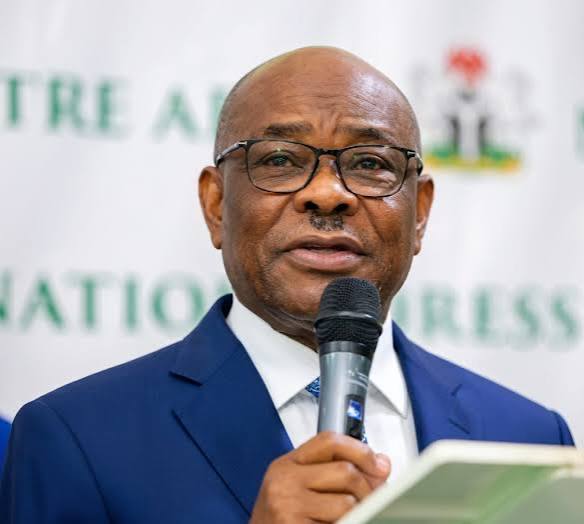
When a top federal official responds to a media critic with words that evoke violence, the implications extend far beyond a heated exchange — they touch the fragile balance between political authority and press freedom in Nigeria’s democracy.
On April 4, comments attributed to Nyesom Wike, Minister of the Federal Capital Territory, ignited a fresh debate about the safety of journalists and the boundaries of political rhetoric. Wike’s remark that “If there was any way to break the screen, I would have shot him” — made during a response to a question from a Channels Television reporter — has drawn sharp rebukes from media advocates, civil society groups, and opposition voices alike.
However, the fallout speaks to deeper currents: anxieties about political centralization, frustration with critical media narratives, and simmering concerns among Nigerians about the narrowing space for dissent.
Advertisement
On April 4, during a press interaction in Abuja, Seun Okinbaloye, a presenter with Channels Television, posed a question suggesting that Nigeria could be drifting toward a one‑party system under the ruling All Progressives Congress (APC). In return, Wike’s response — whether intended as hyperbole or literal threat — was widely shared and quoted across Nigerian news platforms, sparking public outcry.
Credible outlets including Channels TV, The ICIR Nigeria, and Politics Nigeria reported the same exchange but added context missing from the original Daily Post narrative: Wike’s subsequent clarification that he did not literally mean to inflict physical harm, and his framing of the comment as an expression of frustration rather than actionable intent. Those reports also highlighted the broader reaction from civil liberties organisations, such as Amnesty International, which called the remark “irresponsible” and “an attack on media freedom.”
Beyond the soundbite, the incident underscores a wider issue: in a political environment where journalists face intimidation, abuse, and legal harassment, statements by powerful figures — even made in the heat of debate — carry real consequences. Nigeria’s press ecosystem has weathered attacks from state actors before. In 2021, journalists covering protests and security challenges were detained under controversial directives, and online intimidation campaigns have become more frequent in recent election cycles.
The African Democratic Congress (ADC), in a strongly worded statement, described Wike’s comment as emblematic of a government that — having weakened political opposition — now appears bent on silencing critical voices in the press. That framing resonates with broader concerns about democratic backsliding, especially among younger Nigerians and civil society networks. Yet it also omits a crucial dimension: Nigeria’s judiciary still offers recourse for threatened journalists, and regulatory bodies like the Nigeria Press Organisation routinely engage with government representatives over media rights violations.
Data from the Committee to Protect Journalists and Reporters Without Borders show that press freedom in Nigeria — while constitutionally protected — faces persistent threats from rhetoric, legal actions, and at times violence. In the 2025 World Press Freedom Index, Nigeria slipped several places, with expert assessments pointing to regulatory pressures and political interference as driving factors.
The real issue now is how authorities handle the optics and consequences of this exchange. If such remarks go unchecked, they risk normalizing a culture of hostility toward journalists at a moment when Nigeria’s media is already navigating economic pressures, digital disinformation, and political polarization. Civil society groups are urging Wike to issue a public apology; legal experts argue that a clear denunciation of threats — rhetorical or otherwise — is essential to uphold Nigeria’s democratic standards.
Advertisement
For many Nigerians — particularly those in urban centres like Lagos, Abuja, and Port Harcourt — the incident will not be dismissed as mere political theater. Salaried journalists, freelancers, and media producers increasingly see such episodes as symptomatic of a broader challenge: preserving the space for independent reporting amid rising political intensity.
What authorities do next — whether to reaffirm constitutional protections for the press, engage in constructive dialogue with media bodies, or simply let the controversy fade — will shape how Nigerians and international observers judge the state of democratic freedoms here.
You must log in to comment or reply.
Comments