
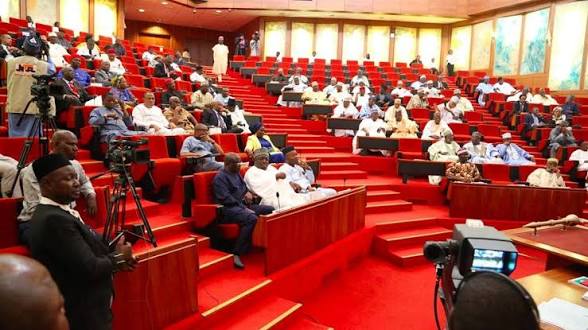
Nigeria’s House of Representatives has moved to tighten the country’s political rulebook, approving an amendment that would criminalise belonging to more than one political party at the same time.
If enacted into law, the measure introduces heavy penalties — including a ₦10 million fine and up to two years in prison — for offenders, marking one of the toughest proposed sanctions against political party indiscipline in recent electoral reforms.
The amendment to the Electoral Act 2026 was passed during Wednesday’s plenary session in the House of Representatives.
Under the new provision, any individual found to be registered as a member of more than one political party simultaneously would face criminal prosecution. The sanctions include:
• A ₦10 million fine
• Up to two years imprisonment
• Or both penalties combined
Advertisement
Lawmakers also inserted new subsections into Section 77 of the Electoral Act, which governs party membership and voter registration processes.
Parliamentarians backing the amendment argue that the change is necessary to restore discipline in Nigeria’s increasingly fluid political landscape, where politicians frequently shift alliances or maintain quiet affiliations across rival parties.
Dual party membership has long existed in a legal grey area in Nigerian politics.
While the Constitution and party rules discourage it, enforcement has been inconsistent, partly because party membership registers are often poorly maintained or politically manipulated.
A closer look at recent electoral controversies reveals why lawmakers may be seeking stronger deterrence.
Disputes over candidate eligibility, party primaries, and defections have frequently reached the courts, sometimes destabilising electoral outcomes even after elections are concluded. In several cases, candidates have been accused of quietly maintaining ties to rival parties while contesting under another platform.
By criminalising the act itself, the amendment attempts to move the issue from internal party discipline to criminal liability.
However, the effectiveness of such a law will depend heavily on implementation mechanisms, particularly how political parties and the Independent National Electoral Commission (INEC) maintain accurate membership databases.
The timing of the amendment is also significant.
Nigeria is already entering the early political manoeuvring phase ahead of the 2027 general elections, a period historically characterised by:
• mass defections between parties
• strategic alliances
Advertisement
• disputes over party primaries
Stricter rules on party membership could reshape how politicians manage these transitions, potentially forcing clearer declarations of allegiance earlier in the electoral cycle.
Yet critics argue the amendment could also become a political weapon, where accusations of dual membership are deployed selectively against opponents.
That concern underscores a broader challenge in Nigeria’s electoral system: laws often exist, but enforcement can become politically contested.
Although the House of Representatives has approved the amendment, the process is not yet complete.
The bill must still pass through the Senate and receive presidential assent before becoming enforceable law.
You must log in to comment or reply.
Comments