
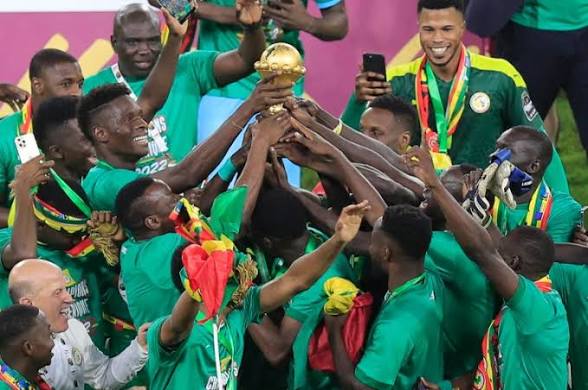
Senegal’s decision to publicly parade the Africa Cup of Nations trophy in Paris has intensified one of African football’s most contentious disputes in recent years. What appeared to be a closed case after a controversial ruling is now evolving into a broader battle over legitimacy, governance, and sporting justice.
The move signals that this is no longer just about a match result—it is about who controls the narrative of victory in African football.
Senegal’s national team, the Teranga Lions, showcased the AFCON trophy before a high-profile friendly against Peru, despite being officially stripped of the title by the Confederation of African Football earlier in March. The original final, played in January, saw Senegal defeat Morocco 1-0. However, CAF’s appeal board later overturned the result, awarding Morocco a 3-0 victory following a controversial walk-off by Senegal players protesting a penalty decision.
Senegal has refused to accept the ruling. Instead, the team has doubled down—retaining the trophy, adding a second star to their jersey, and publicly declaring themselves the rightful champions. Captain Kalidou Coulibaly led the symbolic parade at the Stade de France, reinforcing the team’s stance ahead of their appeal to the Court of Arbitration for Sport.
Advertisement
However, a closer look shows that this standoff reflects deeper fractures within African football governance.
While outlets like The Guardian emphasized the dramatic on-field protest and CAF’s disciplinary justification, Nigerian platforms such as Punch and Daily Post focused more on Senegal’s defiance and emotional response. Both narratives, however, underplay a critical issue: the precedent this sets for future continental competitions. If match outcomes can be reversed weeks later due to disciplinary interpretations, it introduces uncertainty that could undermine trust in tournament integrity.
Beyond the official statements, Senegal’s reaction is also strategic. By parading the trophy publicly, they are shaping global perception ahead of the CAS ruling. In modern sports disputes, perception often runs parallel to legal outcomes. The longer Senegal maintains its claim in the public eye, the harder it becomes for any final verdict to feel universally accepted.
What makes this more complex is CAF’s reasoning. The governing body cited a 14-minute walk-off during the final—an act of protest—as grounds for overturning the result. While disciplinary enforcement is standard, retroactively awarding a final via a 3-0 default scoreline is rare at this level, especially after the match had concluded and celebrations had already taken place.
Historically, African football has faced similar governance controversies. From disputed refereeing decisions to administrative reversals, such incidents have often exposed institutional weaknesses. However, few have escalated to this level—where a champion refuses to relinquish the trophy and escalates the matter to international arbitration.
For Nigeria and other African football stakeholders, the implications are significant. The credibility of CAF competitions directly affects sponsorship value, broadcast rights, and fan trust—key economic drivers for the sport across the continent. A prolonged dispute risks eroding confidence, especially as African football seeks greater global commercial relevance.
Advertisement
Meanwhile, Morocco appears to be taking a different approach. Players like Yassine Bounou have avoided engaging publicly with the controversy, focusing instead on preparations for upcoming competitions. This contrast in strategy—Senegal’s public defiance versus Morocco’s institutional alignment—highlights two competing philosophies: one rooted in protest, the other in procedural acceptance.
Senegal’s coach, Pape Thiaw, has maintained that titles are won “on the pitch,” a statement that resonates with fans but sidesteps the regulatory framework governing international football. That tension—between sporting merit and institutional authority—is now at the heart of the dispute.
The real test now is not just the ruling from the Court of Arbitration for Sport, but whether African football can emerge from this crisis with stronger, clearer rules that prevent similar controversies. What authorities do next will determine whether this episode becomes a turning point—or another unresolved chapter in the sport’s governance challenges.
You must log in to comment or reply.
Comments