
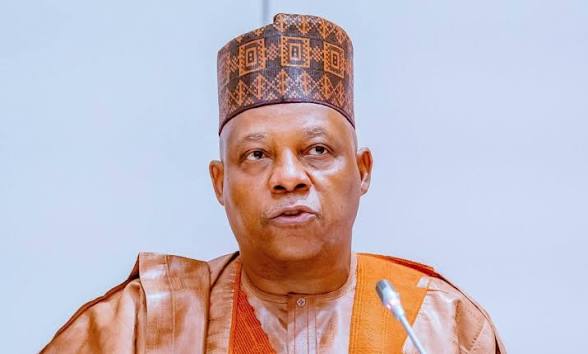
At a ceremonial reception in Adamawa State, Vice President Kashim Shettima’s affirmation that Governor Ahmadu Fintiri now leads the APC locally marks more than a symbolic title shift. It signals a strategic consolidation of power in Nigeria’s Northeast — a region pivotal to the ruling party’s 2027 electoral ambitions.
On March 23, 2026, a high‑profile gathering in Yola underscored shifting currents within Nigerian politics. Vice President Kashim Shettima, speaking on behalf of President Bola Tinubu, formally recognised Governor Ahmadu Fintiri — recently defected from the Peoples Democratic Party (PDP) — as the leader of the All Progressives Congress (APC) in Adamawa State.
Shettima’s remarks came amid questions about leadership within the Adamawa APC following Fintiri’s defection. Previously, National Security Adviser Nuhu Ribadu, a former top security official and influential APC figure, was widely seen as the party’s state leader. Shettima sought to settle that debate, citing examples from other states where governors hold primary influence locally — such as Governor Babagana Zulum in Borno and Governor Caleb Mutfwang in Plateau — to justify Fintiri’s position.
Advertisement
During the reception, APC National Chairman Prof. Nentawe Yilwatda symbolically handed Fintiri the party’s broom flag, urging him to rally others under the APC umbrella. Fintiri wasted no time reaffirming his intent to expand the party’s ranks, reportedly persuading former ADC governorship candidate Senator Abdulazeez Nyako to return to the APC a day earlier.
Mainstream Nigerian outlets, including The Guardian and Premium Times, have confirmed the core facts: Fintiri’s defection and his new role within the APC. Many reports emphasise the broader implications for the 2027 elections, especially with the APC seeking to strengthen its base in the Northeast — traditionally a battleground region with a mix of PDP and APC support.
However, some early accounts leaned heavily into official praise and celebrations, glossing over underlying tensions. Few have delved into how this internal leadership shift might reshape local party dynamics given Ribadu’s continued prominence in national security circles. Nor have they fully contextualised the political calculation behind recruiting former rivals like Nyako — a move that suggests the APC sees potential fragmentation among opposition ranks.
This transition reflects more than goodwill between political actors; it reveals a sharpening focus on electoral strategy. Adamawa — the home state of Atiku Abubakar, former PDP presidential candidate and significant national opposition figure — represents a symbolic and strategic frontline. For the APC, elevating Fintiri helps position the party as both dominant locally and capable of winning over leaders traditionally aligned with the PDP.
That dynamic matters because Nigerian gubernatorial politics often set the tone for federal voting behaviour. By consolidating leadership under an incumbent governor known for cross‑party alliances, the APC may be attempting to fracture opposition cohesion in a region critical for electoral math in 2027.
At the same time, this reshuffling raises questions about internal party balance. Ribadu’s role as the state’s previous APC leader and Nigeria’s NSA suggests dual spheres of influence — national security and party politics — that now must coexist or compete.
Advertisement
Nigeria’s 2027 elections are already commanding national attention. The APC, in power federally since 2015, is navigating regional strongholds against a resurgent PDP. In the Northeast, security challenges and political loyalty intersect, making defections like Fintiri’s both symbolically significant and practically impactful.
Recent trends show that high‑profile defections can influence local electoral outcomes, as seen in other states where ruling party defections preceded shifts in voting patterns. Political analysts note that in competitive states like Adamawa, leadership clarity within a party can be decisive for grassroots mobilisation.
You must log in to comment or reply.
Comments