
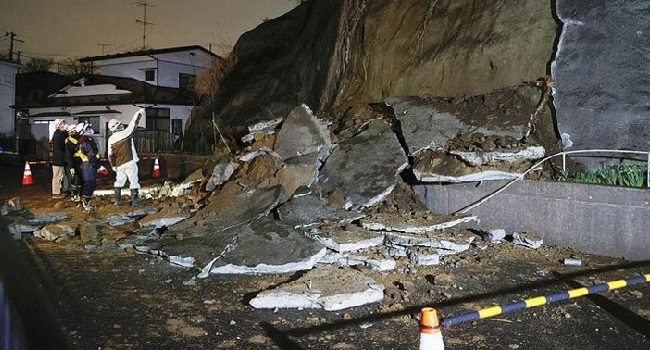
A powerful overnight earthquake in southern China has left at least two people dead, forced thousands from their homes, and renewed concerns over structural safety in rapidly urbanising parts of the country. The 5.2-magnitude tremor struck Guangxi province in the early hours of Monday, collapsing buildings and sending residents fleeing into the streets.
Beyond the immediate destruction, the incident highlights China’s recurring struggle with earthquake preparedness in densely populated regions where older residential structures remain vulnerable despite years of infrastructure expansion.
Chinese state media reported that the earthquake struck Liuzhou city in Guangxi at about 12:21 a.m. local time on Monday. According to state broadcaster CCTV and news agency Xinhua, the quake caused 13 buildings to collapse and led authorities to evacuate more than 7,000 residents from affected communities.
The two confirmed victims were identified as a 63-year-old man and a 53-year-old woman. Rescue teams were still searching for at least one missing person hours after the quake.
Advertisement
Videos aired by Chinese media showed frightened residents rushing out of high-rise apartment buildings shortly after the tremor. Emergency workers, rescue dogs, firefighters and heavy construction equipment were later deployed to search through piles of rubble and clear damaged structures.
Officials said several aftershocks were recorded following the main quake, increasing fears among residents already displaced from their homes.
China experiences frequent earthquakes due to its location along major seismic fault lines, but recent years have exposed growing risks tied to urban density and ageing infrastructure.
Last January, a devastating earthquake in Tibet killed more than 120 people and damaged thousands of homes. The Guangxi quake, although significantly smaller, again demonstrates how even mid-level tremors can become deadly when residential buildings are not adequately reinforced.
What makes this more complex is the economic impact that follows such disasters. Temporary displacement of thousands of residents strains local emergency resources, disrupts businesses and affects transportation networks. Reconstruction costs can also place pressure on regional governments already managing slowing economic growth and rising infrastructure spending.
For countries like Nigeria, where rapid urban expansion continues in cities such as Lagos, Port Harcourt and Abuja, the incident carries an important lesson about construction standards and emergency preparedness. Urban planners and disaster management agencies across developing economies are increasingly facing similar questions: are fast-growing cities truly prepared for natural disasters?
China records hundreds of earthquakes annually, though many are too weak to cause major damage. Southwestern and southern regions remain particularly vulnerable because of complex geological fault systems.
According to historical seismic data, stronger earthquakes in China have repeatedly exposed gaps in emergency housing, construction quality and rural infrastructure resilience. The 2008 Sichuan earthquake, one of the country’s deadliest modern disasters, killed nearly 70,000 people and triggered sweeping reforms in building regulations.
Advertisement
Yet smaller quakes continue to reveal uneven implementation of those reforms, especially in secondary cities and rural provinces.
Experts say moderate earthquakes between magnitude 5.0 and 6.0 can still cause significant destruction when they occur close to the surface or near populated communities — conditions that appear consistent with the Guangxi incident.
The immediate focus remains on rescue efforts and ensuring displaced residents have temporary shelter. But the broader challenge for Chinese authorities will be determining whether current building safety standards are sufficient for rapidly expanding urban districts outside the country’s wealthiest cities.
You must log in to comment or reply.
Comments