
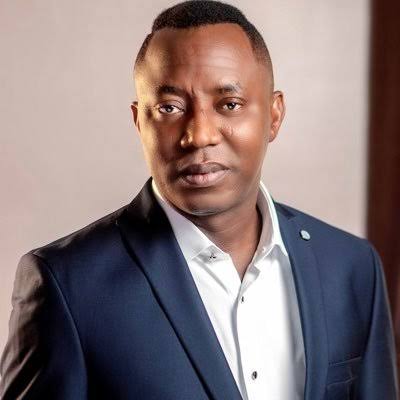
A peace agreement is only as credible as the consequences attached to breaking it. Omoyele Sowore’s criticism of Nigeria’s latest electoral Peace Accord may be provocative, but it raises a legitimate question ahead of 2027: can another public promise of peaceful conduct succeed if political actors face little visible consequence when violence occurs?
African Action Congress presidential candidate Omoyele Sowore on Tuesday, August 18, 2026, criticised the National Peace Accord being signed ahead of the 2027 general election, describing the exercise as increasingly ceremonial.
Speaking to journalists in Abuja on the sidelines of the National Peace Accord ceremony organised by the National Peace Committee, chaired by former Head of State General Abdulsalami Abubakar, Sowore said he did not have confidence in the accord but was participating because he wanted to bring “faith to the system.”
He questioned the description of Nigeria’s recent Osun governorship election as peaceful and claimed that 50 people died in connection with the poll. That figure should be treated as Sowore’s claim rather than an independently established death toll, as available independent reporting and official material reviewed for this article do not substantiate 50 election-related deaths.
What is established is that violence was a serious concern before the August 15 Osun election. The police convened stakeholder meetings over rising political violence, while INEC identified 385 potential flashpoints across the state ahead of the poll.
INEC had also publicly insisted before the election that the outcome should be determined by ballots rather than violence. The commission said more than 2.3 million registered voters were eligible for the poll and maintained that violence would not determine the result.
Sowore further criticised the election results process, arguing that INEC had not completed uploading results and that a genuinely credible election should not be declared while outstanding results remain unresolved.
His sharpest criticism, however, was directed at the Peace Accord itself. He argued that candidates could sign a document promising peaceful elections and then return to political activity without facing meaningful consequences for violations.
Sowore proposed what he called a “Justice Accord”, under which breaches of the peace agreement would attract enforceable consequences.
He also criticised Osun Governor-elect Ademola Adeleke for endorsing President Bola Tinubu after the election, particularly the explanation that the endorsement was based on shared Yoruba identity. Sowore argued that a governor represents citizens from different ethnic and religious backgrounds and should therefore frame political decisions in broader civic rather than ethnic terms.
The August 18 ceremony is part of Nigeria’s preparations for the 2027 elections. INEC has scheduled the presidential and National Assembly elections for January 16, 2027, followed by governorship and State House of Assembly elections on February 6, 2027.
Sowore's criticism should not automatically be accepted as proof that the Peace Accord has failed. But it deserves attention because it exposes the central weakness of voluntary political commitments: a promise can create expectations without necessarily creating enforcement.
The National Peace Committee itself recognises that problem.
In its assessment of the 2023 elections, the committee acknowledged that the impact of its work did not fully match public expectations, citing, among other factors, non-compliance with the Peace Accord by key political actors. The committee argued that the lessons of 2023 should inform efforts to make the mechanism more effective before 2027.
Advertisement
That makes the argument over a “Justice Accord” more than a rhetorical exchange between Sowore and the Peace Committee.
The real question is whether political parties and candidates understand that signing an agreement creates obligations beyond the ceremony itself.
The National Peace Committee has attempted to strengthen the framework. Earlier in 2026, it presented an Annotated Peace Accord intended to provide clearer guidance and preventive engagement. General Abdulsalami Abubakar described the accord as an instrument for accountability and restraint, while INEC said rebuilding public trust was essential to credible elections.
That is significant.
It means the organisers themselves do not view the accord simply as a photo opportunity. The difficulty lies in translating the commitment into behaviour when political competition becomes intense.
There are two competing interpretations of the Peace Accord.
The institutional argument is that the accord provides an important platform for dialogue, public commitment and conflict prevention. The National Peace Committee says it has served as a stabilising mechanism since 2015, while INEC has described it as an important platform for political actors to commit themselves to non-violence.
There is logic to that position. Political agreements do not need to prevent every act of violence to have value. They can establish common standards, open communication channels and provide a basis for intervention when tensions rise.
But the Sowore argument is that political declarations mean little if the system cannot demonstrate consequences when those declarations are violated.
That criticism becomes particularly relevant in a country where election-related violence has repeatedly been a concern.
Osun itself illustrates the dilemma. Before the August election, police authorities were sufficiently concerned about political violence to hold stakeholder meetings and issue repeated warnings. INEC also identified hundreds of potential flashpoints.
The existence of those warnings does not prove that every subsequent allegation of violence is accurate. But it demonstrates why public confidence in the electoral security architecture matters.
The Osun election was explicitly viewed by election authorities and political stakeholders as an important test ahead of 2027.
In July, Abdulsalami Abubakar described the Osun election as a critical test run for the national elections, while INEC Chairman Joash Amupitan said the commission was working to deliver credible polls despite operational and legal challenges.
That makes the post-election debate important.
If candidates and voters believe that peace agreements are merely ceremonial, the accord could gradually lose its deterrent value. If, however, political actors see it as part of a broader system involving monitoring, public accountability, security intervention and prosecution of offences, it could become more meaningful.
This is where Sowore's proposal deserves a more careful reading.
A “Justice Accord” would only be useful if it complemented existing Nigerian law rather than becoming another political document with uncertain enforcement powers. Electoral violence, intimidation, vote buying and other offences already fall within the country's legal framework. The challenge is often not the absence of rules but their consistent enforcement.
That distinction matters.
Nigeria does not necessarily need another document promising punishment. It needs institutions capable of investigating alleged violations, establishing responsibility and applying existing laws fairly regardless of party affiliation.
Sowore's criticism of Adeleke's endorsement of Tinubu also exposes another dimension of Nigerian politics: the tension between ethnic identity and political representation.
Adeleke's political choice is ultimately his to make. But Sowore's broader argument — that elected officials govern diverse constituencies rather than ethnic blocs — reflects a legitimate democratic principle.
Nigeria's political landscape is complicated by ethnicity, religion, regional alliances and party calculations. None of those factors can simply be wished away.
The challenge for elected officials is to ensure that political decisions do not reduce citizens to ethnic categories.
That debate is likely to become even more prominent as the 2027 campaign intensifies.
The immediate consequence of the Peace Accord is symbolic: presidential and other candidates publicly committing themselves to peaceful elections.
Advertisement
The longer-term test will be practical.
Political parties will have to demonstrate that they can control their supporters. Security agencies will have to investigate violence without partisan bias. INEC will have to communicate results and electoral procedures clearly enough to reduce unnecessary suspicion. And the judiciary and law-enforcement institutions will have to respond credibly when electoral offences are alleged.
The stakes extend beyond Abuja.
If voters in Lagos, Osun, Kano, Rivers, Anambra or any other state believe elections can be contested without fear, participation becomes easier and democratic legitimacy becomes stronger. If voters instead associate elections with intimidation, violence or impunity, the damage goes beyond one election cycle.
The Peace Accord therefore should not be judged by how impressive the signing ceremony looks.
It should be judged by what happens when political competition becomes difficult.
Ultimately, the question is not whether Nigeria should have a Peace Accord. It should.
The harder question is what happens after the signatures, photographs and speeches.
Sowore is right to challenge the country to think about enforcement, even if his claim of 50 deaths in the Osun election remains unverified. The National Peace Committee is equally right that dialogue, restraint and public commitments have a role to play in protecting elections.
But peace without accountability is fragile.
As Nigeria moves toward the January and February 2027 elections, the credibility of the Peace Accord will depend less on the ceremony in Abuja than on whether political actors, security agencies and institutions demonstrate that breaking the rules has consequences.
What happens next will determine whether the accord becomes a meaningful democratic safeguard — or simply another familiar ritual in Nigeria's electoral calendar.
You must log in to comment or reply.
Comments