
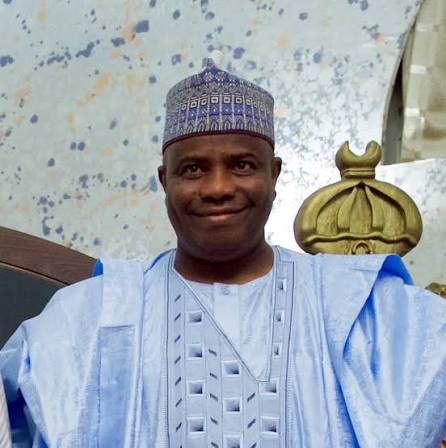
A major shift is unfolding inside Nigeria’s opposition politics. Former Sokoto State governor and ex–House Speaker Aminu Waziri Tambuwal has formally resigned from the Peoples Democratic Party (PDP), citing deepening internal disputes, and has moved to the African Democratic Congress (ADC).
The decision arrives at a delicate moment for the PDP, which is already grappling with internal fractures as political actors quietly reposition ahead of Nigeria’s next electoral cycle.
Tambuwal announced his resignation in a statement posted on his official social media account early Thursday, saying he had already communicated his decision formally to his ward chairman.
The former governor, who led Sokoto State for two terms and previously served as Speaker of the House of Representatives of Nigeria, described the decision as the result of prolonged consultations with allies and supporters.
According to him, the persistent crisis inside the PDP — including leadership disagreements and factional divisions — had eroded the cohesion that once defined the party.
Tambuwal acknowledged that the PDP had played a significant role in his political career but said the current environment within the party made continued membership increasingly difficult.
Advertisement
In explaining his choice of party, Tambuwal said he believes the ADC offers a stronger framework for democratic competition and national development.
He framed the move around principles such as integrity, accountability, and inclusiveness, suggesting that the platform could help rebuild a more credible opposition structure in Nigeria’s evolving political landscape.
The announcement also signals the ADC’s growing ambition to position itself as a rallying ground for politicians seeking alternatives outside the traditional two-party dominance.
Tambuwal’s exit adds to a broader pattern of turbulence inside the PDP over the past several years.
Since the 2023 election cycle, the party has struggled to maintain internal cohesion, facing factional disagreements over leadership structures, zoning arrangements, and strategy for rebuilding national influence.
These tensions have often spilled into public disputes among senior party figures, weakening the PDP’s ability to project a unified opposition voice.
When prominent figures begin to leave under such circumstances, it raises deeper questions about whether the party can still function as the central anchor of opposition politics in Nigeria.
What makes the development more consequential is the destination: the ADC.
Historically considered a smaller political platform, the party has increasingly attracted attention from politicians exploring new alliances outside the dominant parties.
Tambuwal’s arrival adds significant political weight — particularly in northern Nigeria — and could encourage further realignments among political actors seeking viable alternatives.
For the ADC, the challenge will be converting high-profile defections into a coherent national structure capable of competing effectively in future elections.
Nigeria’s political system has long revolved around a few dominant parties, but the constant cycle of internal crises and defections has begun to reshape that landscape.
Advertisement
Tambuwal himself has experienced multiple party shifts throughout his career — reflecting a broader pattern within Nigerian politics where alliances evolve rapidly as elections approach.
In that context, the latest defection may be less about a single politician’s decision and more about the gradual reconfiguration of opposition politics ahead of the next major electoral contest.
The immediate impact of Tambuwal’s move will be felt within the PDP, which must now contend with the loss of another influential figure at a time when party unity remains fragile.
The larger question, however, is whether the ADC can transform these political migrations into a credible national coalition. Nigeria’s opposition landscape has repeatedly seen alliances form and dissolve under pressure.
What happens next will depend not only on who joins the emerging platforms, but on whether those alliances can build the organizational strength and policy clarity required to challenge entrenched political power.
You must log in to comment or reply.
Comments