
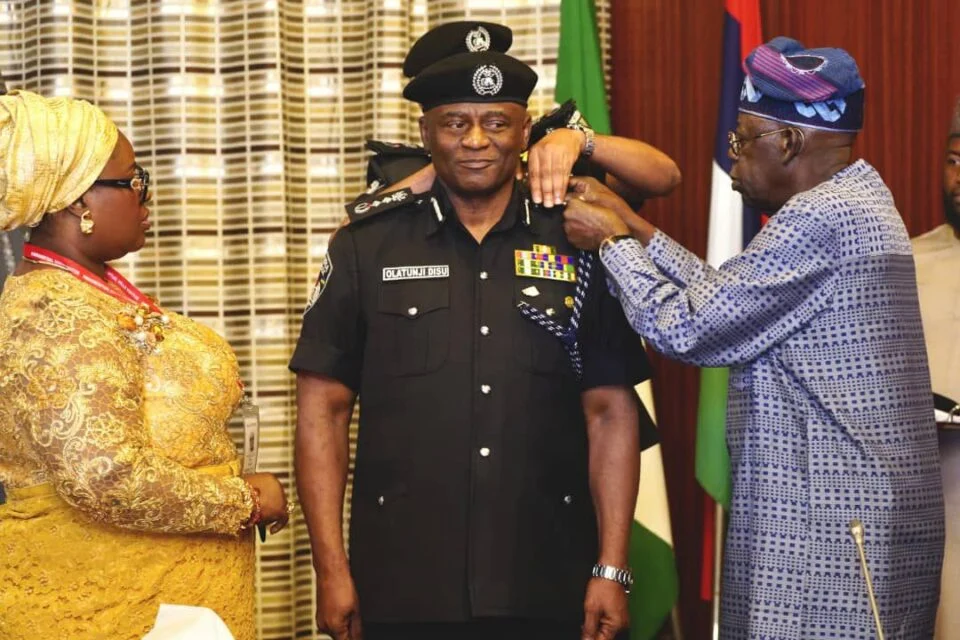
Nigeria’s police leadership changed hands on Wednesday in a transition that carries more weight than ceremony. Within 24 hours of the resignation of Kayode Egbetokun, President Bola Ahmed Tinubu decorated Tunji Disu as Acting Inspector-General of Police, charging him to rebuild discipline and restore public trust at a time of worsening insecurity.
Disu formally assumed duty after taking his first salute at Force Headquarters in Abuja, marking a swift and symbolically choreographed transfer of authority. Egbetokun had cited family reasons for stepping down, but the speed of the change underscores the urgency surrounding Nigeria’s security environment.
During the decoration at the State House, Tinubu framed the appointment as a “defining moment” amid persistent banditry, terrorism, kidnapping, and violent crime. He urged the new police chief to strengthen discipline, improve inter-agency collaboration, and prioritise the safety of lives and property.
Advertisement
Disu, visibly emotional, pledged zero tolerance for corruption and an end to impunity, promising to emphasise human rights compliance and public cooperation.
Nigeria’s police force — Africa’s largest — faces long-standing challenges: underfunding, allegations of brutality, low morale, and strained public confidence since the 2020 #EndSARS protests. While the President’s remarks emphasised professionalism and discipline, there was limited discussion of measurable reform benchmarks, funding realities, or institutional independence.
Beyond the official statements, the deeper issue is capacity. Nigeria continues to grapple with multi-front security threats — from insurgency in the North-East to rural banditry and urban violent crime. Leadership change alone does not resolve manpower shortages, outdated equipment, or coordination gaps between federal and state security actors.
Disu’s prior experience, including service in Lagos and as Principal Staff Officer to his predecessor, positions him as an insider reformer rather than an external disruptor. That continuity could stabilise command structures. But it also raises the question of how much systemic overhaul is realistically possible without broader policy shifts.
Advertisement
Tinubu’s public endorsement — including personal references to Disu’s Lagos track record — signals political ownership of the appointment. In doing so, the presidency has tied part of its security credibility to the new acting IG’s performance.
What authorities do next will determine whether this transition marks genuine institutional reform or merely another change of face at the top of a strained force.
You must log in to comment or reply.
Comments