
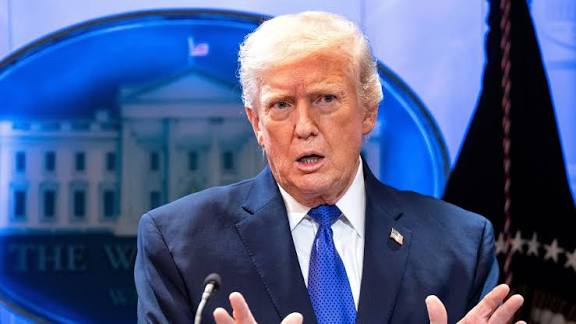
The war between the United States and Iran has entered a more confrontational phase, with unusually blunt rhetoric from Washington. President Donald Trump declared it an “honour” to eliminate Iran’s leadership, framing the ongoing military campaign as both retaliation and a decisive attempt to dismantle Tehran’s power structure.
The remarks come as airstrikes and missile exchanges continue to ripple across the Middle East, raising fears that the conflict could reshape regional power dynamics.
Trump’s statement followed nearly two weeks of escalating military action after the United States and Israel launched coordinated strikes on Iranian military and government targets on February 28. The operation reportedly killed several senior officials, including Iran’s longtime supreme leader Ali Khamenei.
Posting on social media, Trump described Iran’s leadership as “deranged” and claimed American forces were systematically dismantling the country’s military capabilities.
His comments echoed earlier remarks in which he said large portions of Iran’s senior leadership had been eliminated during the opening stages of the campaign.
Military officials in Washington have supported that narrative, describing the strikes as part of a broader effort to neutralise Iran’s missile systems, air force and strategic command infrastructure.
However, the battlefield picture is more complex.
Advertisement
While some U.S. statements have emphasised the destruction of Iran’s military network, international coverage has focused more heavily on the wider consequences.
Reports from global outlets indicate that thousands of targets across Iran have been hit during the conflict, while missile and drone attacks launched by Tehran have spread across the Gulf region.
Iran has also warned that regional oil infrastructure and the strategic Strait of Hormuz could become targets if the conflict continues.
Another development drawing attention is the emergence of a new Iranian leadership structure following the reported killing of Khamenei. Clerical authorities in Tehran quickly moved to appoint his son, Mojtaba Khamenei, as the country’s new supreme leader, although he has not appeared publicly since the war began.
That rapid succession suggests Iran anticipated the possibility of a leadership strike long before the war erupted.
The targeting of top Iranian officials marks one of the most dramatic attempts in modern geopolitics to decapitate a state’s leadership during active conflict.
Such strategies aim to destabilise command structures and accelerate political collapse. But history shows the results can be unpredictable.
Iran’s system of clerical rule was built with overlapping chains of authority precisely to survive leadership shocks. Even after the loss of senior figures, military institutions such as the Islamic Revolutionary Guard Corps remain intact.
Meanwhile, the economic impact of the war is spreading far beyond the region.
Oil prices have surged past $100 per barrel amid fears that shipping routes through the Strait of Hormuz could be disrupted.
Global energy markets are therefore watching the conflict almost as closely as military analysts.
The strikes have also drawn criticism from several world leaders.
Advertisement
Russian President Vladimir Putin condemned the killing of Iran’s supreme leader as a violation of international norms, warning that the conflict could destabilise the wider Middle East.
Meanwhile, diplomatic efforts at the United Nations have struggled to produce a ceasefire framework as missile exchanges continue.
Iran has already launched hundreds of missiles toward Israel and U.S.-aligned states in the Gulf, raising the possibility that neighbouring countries could be pulled further into the conflict.
For Washington, the immediate objective appears to be weakening Iran’s military command structure and preventing any future nuclear capability.
Yet the deeper challenge is political.
Removing leaders does not necessarily remove the systems that produced them. The real test now is whether the war forces meaningful change inside Iran’s power structure — or simply deepens a cycle of retaliation that could destabilise the region for years.
You must log in to comment or reply.
Comments