
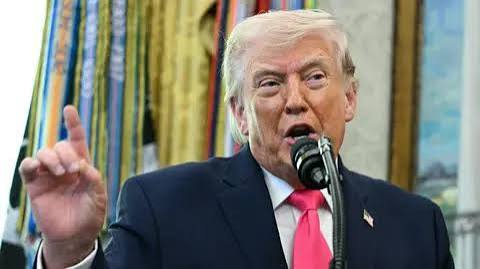
President Donald Trump’s public remarks this week have escalated uncertainty over the U.S.–Iran conflict, tethering any prospect of a ceasefire to control of the Strait of Hormuz — a critical artery for global oil supplies. As allies and adversaries alike parse those comments, the geopolitical and economic implications extend far beyond Washington’s messaging.
On April 1, 2026, in a series of posts on his Truth Social platform, President Trump said he would only entertain a ceasefire request from Iran if the Strait of Hormuz were “open, free and clear,” underscoring the waterway’s outsized role in global energy flows.
However, a closer look at reporting by Reuters, the London Evening Standard, and ABC News shows that while Trump repeatedly tied negotiations to securing the strait, there is no independent confirmation from Iranian officials that Tehran has formally requested a ceasefire. This nuance — absent from the original Daily Post article — fundamentally alters how the claim should be understood.
Advertisement
Beyond the official statement, reporting from major outlets highlights broader diplomatic tension: allies in the North Atlantic Treaty Organization (NATO) have expressed reservations about Washington’s approach, and Trump is said to be weighing a potential U.S. withdrawal from the alliance if it cannot align with his strategy. That context — referenced briefly in other platforms — was missing in the original source but is central to understanding why global partners are uneasy.
What makes this more complex is the strategic calculus of the Strait of Hormuz itself. Roughly one‑fifth of the world’s petroleum passes through the strait. Any disruption or perceived threat to that flow ripples into global oil markets, directly affecting Nigerian fuel prices, inflationary pressures, and foreign exchange. For an economy where energy imports and FX volatility shape everyday life, geopolitical shifts in the Gulf are not abstract — they matter at the pump and on the shelf.
Yet neither the original Daily Post report nor some secondary summaries sufficiently foreground this economic dimension. Nor do they stress that independent confirmation of Iran’s ceasefire overture is absent; Trump’s claim currently stands as his interpretation, not verified diplomatic fact.
Historical comparisons offer further depth. In past Gulf crises, such as the 2019 tanker confrontations that briefly spiked oil prices, markets reacted swiftly to even unverified threats to Hormuz traffic. Today’s rhetoric, coming amid persistent conflict, could similarly spook markets and policymakers alike.
Advertisement
The deeper issue is that U.S. messaging about conditions for diplomacy — tied to control of a key maritime chokepoint — signals a fusion of military leverage and economic pressure. For global allies reliant on uninterrupted energy flows and for energy‑importing countries like Nigeria, this blend complicates both energy security and diplomatic coordination.
Indeed, analysts warn that the real test now is whether Washington and its partners can decouple tactical battlefield objectives from the broader effort to stabilize regional economies and reassure markets. What governments, investors, and ordinary citizens do next will determine whether this latest rhetoric becomes mere posturing or a turning point in one of the world’s most consequential geopolitical standoffs.
You must log in to comment or reply.
Comments