
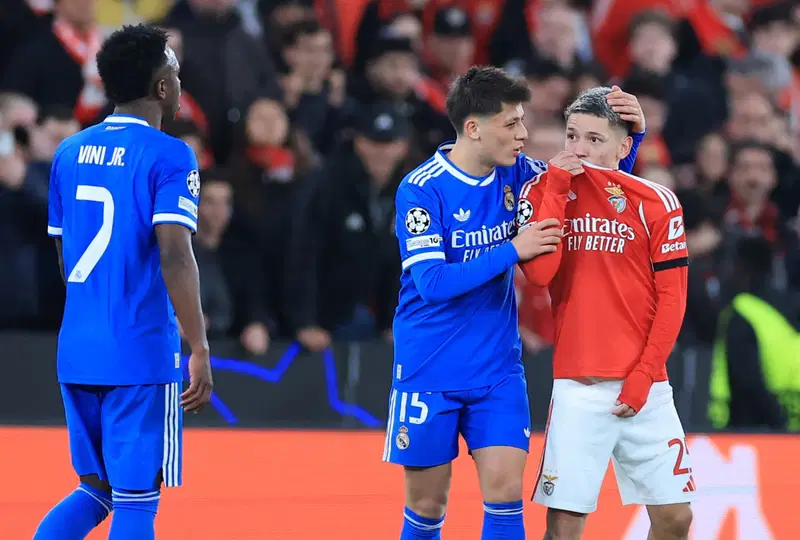
Most people are focusing on the goal. But here’s the real issue: Europe’s biggest football stage was stopped — again — because of alleged racism.
When Vinícius Júnior scored Real Madrid’s winner in Lisbon, the night should have belonged to football. Instead, it turned into another chapter in the sport’s long-running battle with discrimination.
This could force UEFA into a defining moment — and here’s why.
What Happened in Lisbon
During UEFA Champions League action between Real Madrid and SL Benfica, the match was halted for more than 10 minutes after Vinícius Júnior alleged he was racially abused.
The Brazilian forward reported being called “mono” (Spanish for monkey) during an exchange with Benfica’s Gianluca Prestianni. Referee François Letexier activated UEFA’s anti-racism protocol, pausing the game.
Real Madrid went on to secure a 1–0 away victory — but the football became secondary.
Alexander-Arnold and Mbappé React
Teammate Trent Alexander-Arnold did not mince words.
Advertisement
“It’s disgusting. What’s happened tonight is a disgrace for football.”
Meanwhile, Kylian Mbappé reportedly called for strict consequences if the allegations are proven, stating such behavior has no place in Europe’s top competition.
Benfica coach José Mourinho said the accused player denied making racist remarks, and criticized Vinícius’s goal celebration, suggesting it inflamed tensions.
The situation remains one of allegation versus denial — and UEFA is expected to review reports and footage.
A Pattern, Not an Isolated Incident
Vinícius, 25, has faced multiple racist incidents during his career in Spain.
In 2023, he confronted abuse at Valencia’s Mestalla. In 2024, individuals were convicted after hanging a dummy resembling him from a bridge in Madrid — a case authorities described as a hate crime.
But here’s the bigger question…
How many incidents does it take before deterrence becomes real?
3 Key Things You Should Know
1. UEFA’s racism protocol includes stadium announcements, match suspension, and potential abandonment.
2. Several clubs across Europe have faced fines and partial stadium closures for racist incidents in recent years.
3. Repeated abuse incidents risk damaging the Champions League’s global brand and commercial partnerships.
This is no longer just a disciplinary matter — it’s a reputational crisis for European football.
The Celebration Debate: Distraction or Deflection?
Some critics argue Vinícius’s celebratory style provokes opposition fans. Others say that framing the discussion around celebration shifts focus from the core issue: racism itself.
Advertisement
What happens next may surprise you.
If UEFA imposes strong sanctions, it could set a new standard. If the outcome is perceived as weak, critics may argue the system lacks deterrence.
Either way, this case will likely shape the conversation around racism in elite football heading into the latter stages of the tournament.
Football’s Image Under Pressure
The Champions League markets itself as the pinnacle of club football — global, inclusive, elite.
Yet recurring racism controversies threaten that narrative.
For sponsors, broadcasters, and fans worldwide, the question is no longer whether racism exists in football.
It’s whether the sport is serious enough about eliminating it.
You must log in to comment or reply.
Comments