
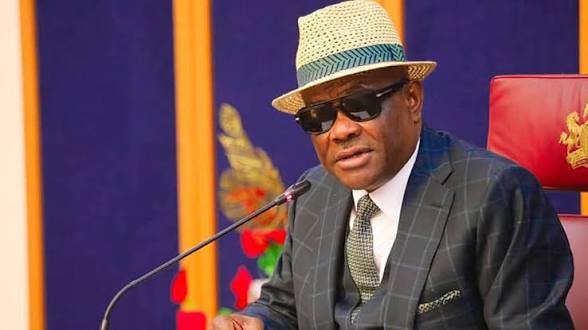
The visit by Federal Capital Territory Minister, Nyesom Wike, to the residence of APC National Chairman Nentawe Yilwatda has reignited debate over shifting political alliances ahead of Nigeria’s 2027 elections.
While opposition figures and political observers interpreted the meeting as a possible sign of deeper alignment with the ruling party, Wike has dismissed the speculation, insisting the interaction was personal rather than political. Yet the controversy surrounding the visit highlights how fragile and unpredictable Nigeria’s political coalitions have become.
Speaking on Wednesday during an inspection of road projects in Karu, Apo-Karshi, and Kubwa in Abuja, Wike defended his decision to visit Yilwatda at his residence earlier in the week.
The minister said the APC chairman had previously attempted to see him multiple times at his office, making the visit a simple return gesture rather than a strategic political meeting.
“We were all colleagues before he left for the chairmanship of APC. So, what I should do anytime I see him is to hide?” Wike told journalists.
He also questioned why ordinary political interactions now trigger intense national speculation.
“Anytime he sees me, he should run away so people will not say something?” he added.
Advertisement
Wike rejected criticism over the absence of an official statement after the meeting, arguing that he is under no obligation to publicly explain his personal relationships.
The former Rivers State governor, who remains officially a member of the Peoples Democratic Party while serving in President Bola Ahmed Tinubu’s cabinet, said freedom of association should not be restricted by party lines.
“What’s important to me is what I’m doing for my people,” Wike stated, adding that his focus remains infrastructure delivery and satisfying his “appointor.”
The controversy surrounding Wike’s meeting with the APC chairman reflects a growing collapse of rigid party boundaries in Nigerian politics.
Wike’s continued influence inside the Tinubu administration despite remaining in the PDP has already blurred traditional opposition lines. His role in Abuja infrastructure projects, coupled with his close relationship with key APC figures, has made him one of the most politically unusual figures in the country.
However, a closer look shows that the real issue is not merely whether Wike defects officially. The bigger concern for many opposition supporters is whether the PDP can maintain internal unity ahead of the next election cycle.
That anxiety has intensified since the Rivers political crisis fractured parts of the party’s structure. For many observers, Wike’s growing comfort within APC circles symbolizes the weakening of ideological opposition politics in Nigeria.
Yet the deeper issue is also about governance optics.
Wike appears determined to project himself as a results-driven administrator rather than a party loyalist. During the project inspection, he repeatedly shifted attention back to roads and infrastructure delivery in the FCT instead of partisan arguments.
That strategy may resonate with voters frustrated by party conflicts but more concerned about visible governance outcomes like roads, transport access, and urban development.
The meeting comes at a politically sensitive moment.
Preparations and early alignments ahead of the 2027 elections have already started quietly across major parties. Political camps are repositioning, governors are consolidating influence, and strategic alliances are forming long before official campaigns begin.
Nigeria has seen similar political realignments before.
Ahead of the 2015 elections, several opposition leaders crossed party lines and helped reshape the national political landscape. In 2018 and 2019, defections again became a major tool for negotiating influence and federal access.
Advertisement
Current developments suggest that the next election cycle could witness another round of elite political restructuring.
What makes this more complex is that Wike remains one of the few politicians with significant influence both inside opposition networks and within the ruling government structure.
Wike’s supporters argue that his relationship with APC leaders should not automatically be viewed as betrayal, especially if it improves cooperation between the federal government and the FCT administration.
Critics, however, believe such closeness weakens opposition accountability and confuses party identity.
That tension reflects a broader challenge within Nigerian democracy: balancing governance collaboration with ideological consistency.
For residents of Abuja, though, immediate concerns may be less about party rivalry and more about whether ongoing road projects, transport infrastructure, and urban expansion continue at their current pace.
You must log in to comment or reply.
Comments