
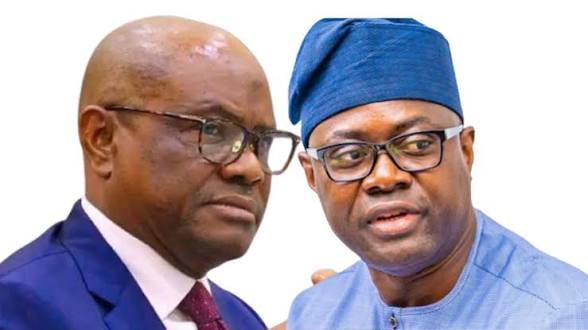
Political tensions within Nigeria’s opposition landscape deepened as the Minister of the Federal Capital Territory, Nyesom Wike, publicly dismissed Governor Seyi Makinde’s presidential ambition. His remarks come at a time when new political alliances are reshaping calculations ahead of the 2027 general elections.
Beyond the headline exchange, Wike’s comments reflect a broader struggle for influence within the Peoples Democratic Party (PDP) and its emerging political alignments.
On Thursday, during an inspection of ongoing road projects in Gomani-Yangoje, Kwali Area Council in Abuja, FCT Minister Nyesom Wike sharply criticized the 2027 presidential ambition of Oyo State Governor Seyi Makinde.
Wike described Makinde’s political move, including his reported alignment with the Allied Peoples Movement (APM) through a PDP faction, as politically unrealistic.
In his words, Wike stated:
“What you have is Seyi Makinde joining APM to be able to actualize his presidential ambition, which is already dead on arrival.”
Advertisement
He further insisted that Makinde would not be able to secure the PDP presidential ticket, adding that his strategy would fail.
Makinde had recently declared his intention to contest for the presidency under an arrangement linked to a PDP–APM political alliance, signaling early positioning ahead of 2027.
Beyond the verbal confrontation, the exchange underscores a widening fault line inside the opposition political structure.
What makes this more complex is not only Makinde’s ambition, but the broader struggle for party control, coalition dominance, and presidential ticket negotiations within Nigeria’s major political blocs.
Wike’s statement is also being interpreted as part of an ongoing effort to assert influence over the PDP’s internal direction, even as the party navigates alliances that blur traditional party boundaries.
At a national level, this kind of early political positioning reflects a recurring pattern in Nigeria’s democracy: elite negotiations intensify long before official campaigns, often shaping outcomes behind the scenes rather than through voter engagement.
Historically, similar pre-election rivalries within major parties have contributed to:
• internal defections
• weakened opposition coordination
• fragmented electoral strategies
Nigeria’s political history shows that pre-election internal disputes often determine electoral strength more than campaign periods themselves.
Advertisement
In previous election cycles (2015, 2019, 2023), early internal divisions within opposition parties significantly reduced their national competitiveness.
Current political analysts note that as early as 2026, alignments around the 2027 elections are already forming, with alliances such as PDP–APM reflecting attempts to restructure electoral strength ahead of time.
This early mobilization highlights the increasing importance of coalition politics in Nigeria, where no single party easily dominates without strategic partnerships.
As 2027 approaches, the real test will be whether opposition figures can transform internal rivalry into coordinated political strategy—or whether early fractures will further weaken their national standing.
Wike’s remarks suggest that the battle is not just about individual ambition, but about who ultimately controls the direction of Nigeria’s opposition politics in the coming election cycle.
You must log in to comment or reply.
Comments